Short-term silica exposure doesn't need months or years to cause real harm. A single shift spent cutting concrete, drilling rock, or grinding engineered stone can push respirable crystalline silica into your lungs at concentrations hundreds of times above safe limits. Yet most safety training fixates on the long game: decades of cumulative exposure leading to chronic silicosis. That framing leaves a dangerous blind spot.
The damage from one high-intensity shift isn't theoretical. Acute silicosis, the most aggressive form of the disease, develops after brief periods of extreme exposure and can progress to respiratory failure within months. This article breaks down exactly how quickly silica dust becomes dangerous, which tasks create the worst spikes, and what you can do right now to protect yourself and your crew.
Can a Single Exposure to Silica Dust Be Dangerous?
Yes. A single, high-intensity exposure to respirable crystalline silica can trigger acute silicosis, a condition where the lungs fill with proteinaceous fluid and become severely inflamed. Documented cases involve workers who spent just weeks or months in uncontrolled environments: sandblasting in enclosed spaces, dry-cutting engineered stone countertops, or tunneling through quartz-rich rock without adequate ventilation.
The key variable isn't just duration. It's concentration. Someone who spends eight hours surrounded by airborne silica at 10 or 20 times the permissible limit absorbs more lung-scarring particles in that single shift than a worker who spends years at or near the limit. Think of it like radiation exposure: a brief, massive dose can be far more destructive than low-level exposure over time.
Why One Shift Matters More Than You Think
Respirable crystalline silica particles are small enough (under 10 micrometers) to bypass your nose and throat and lodge deep in the alveoli, the tiny air sacs where oxygen enters your blood. Once embedded, these particles trigger an inflammatory cascade your body cannot resolve. The silica doesn't dissolve or get absorbed. It stays, and your immune system keeps attacking it, creating scar tissue that stiffens your lungs permanently.
A single overexposure event deposits enough particles to kickstart this process. You won't feel it that day. You might not feel it for weeks. But the damage is already underway.
Acute vs. Chronic vs. Accelerated Silicosis
Not all silicosis is the same, and understanding the differences matters for anyone assessing their risk after a short-term exposure event.
Acute silicosis develops within weeks to a few years of very high-intensity exposure. The lungs fill with a lipid-rich fluid (similar to what happens in a condition called pulmonary alveolar proteinosis), and symptoms escalate rapidly: severe shortness of breath, cough, weight loss, and fatigue. Prognosis is poor, and the disease can be fatal even after exposure stops.
Accelerated silicosis appears within 5 to 10 years of sustained heavy exposure. It resembles chronic silicosis clinically but progresses faster and hits younger workers. This form often develops when short-term overexposures repeat across multiple jobs or tasks without adequate controls.
Chronic silicosis is the most commonly discussed form. It takes 10 to 30 years of lower-level exposure to develop. Because it progresses slowly, many workers don't receive a diagnosis until significant lung scarring has already occurred.
The critical takeaway: acute silicosis is the direct consequence of short-term, extreme exposure. It's rarer than the chronic form, but it's far more immediately life-threatening.
How Much Silica Exposure Is Too Much?
Regulatory limits provide the clearest benchmark. MSHA recently reduced the permissible exposure limit (PEL) for respirable crystalline silica to 50 µg/m³ over an 8-hour time-weighted average, cutting the previous limit in half. OSHA's construction and general industry standards align at the same 50 µg/m³ threshold. NIOSH recommends an even stricter recommended exposure limit (REL) of 50 µg/m³ and has pushed for employers to treat it as an absolute ceiling rather than an average to hover near.
To put these numbers in perspective: dry-cutting a single granite countertop slab in an enclosed shop can generate silica concentrations exceeding 1,000 µg/m³, roughly 20 times the PEL. Sandblasting with silica sand in a confined area can spike concentrations to several thousand µg/m³. These aren't hypothetical worst cases. They're common field measurements from workplace health and safety risk assessments.
Comparing Global Exposure Standards
- Agency / Region: OSHA (U.S.) | Exposure Limit (8-hr TWA): 50 µg/m³ | Notes: Construction and general industry PEL
- Agency / Region: MSHA (U.S.) | Exposure Limit (8-hr TWA): 50 µg/m³ | Notes: Updated 2024, down from 100 µg/m³
- Agency / Region: NIOSH (U.S.) | Exposure Limit (8-hr TWA): 50 µg/m³ REL | Notes: Recommends treating as ceiling, not target
- Agency / Region: EU (SCOEL) | Exposure Limit (8-hr TWA): 50 µg/m³ | Notes: Binding OEL adopted across member states
- Agency / Region: Australia (Safe Work) | Exposure Limit (8-hr TWA): 50 µg/m³ | Notes: Lowered from 100 µg/m³ in recent updates
Global consensus is converging on 50 µg/m³ as the upper boundary. But even this limit may not fully protect workers from long-term effects, which is why NIOSH pilot programs are now testing action levels as low as 25 µg/m³.
High-Risk Tasks for Short-Term Silica Overexposure
Certain tasks generate silica concentrations so extreme that a few hours of unprotected work can exceed an entire shift's allowable dose. These aren't obscure edge cases. They happen on job sites every day.
- Dry-cutting concrete, stone, or engineered quartz with handheld saws produces massive dust plumes. Engineered stone (popular for countertops) often contains over 90% crystalline silica.
- Abrasive blasting with silica-containing media remains one of the highest-exposure activities despite decades of warnings.
- Underground drilling and rock bolting in quartz-bearing formations without wet suppression.
- Demolition of concrete or masonry structures, especially interior demolition where dust stays trapped.
- Sweeping or dry cleanup of silica-containing dust, an often-overlooked source because it doesn't involve power tools.
Non-occupational exposures also matter. Home renovators cutting concrete pavers, DIY countertop fabricators, and anyone disturbing old silica-containing materials in enclosed garages face real risk, often without any awareness of the hazard.
Why TWA Averages Hide the Real Danger
The 8-hour time-weighted average is the standard yardstick for compliance. But it has a serious flaw: it smooths out dangerous peaks. A worker who spends 30 minutes cutting concrete at 2,000 µg/m³ and 7.5 hours in a clean break room might technically fall under the 50 µg/m³ TWA. On paper, that shift looks compliant.
Your lungs don't calculate averages. Those 30 minutes of extreme exposure deposited a massive particle load into your alveoli. The biological damage from that half-hour spike doesn't get diluted by the clean air that followed. This is precisely why understanding the hidden costs of poor silica exposure data is so important for safety teams.
Peak Exposure: The Metric That Matters
Traditional gravimetric sampling collects dust on a filter over the full shift and reports a single number. It cannot tell you when the exposure happened or how intense any individual task was. If your only data point is the TWA, you're flying blind during the moments that matter most.
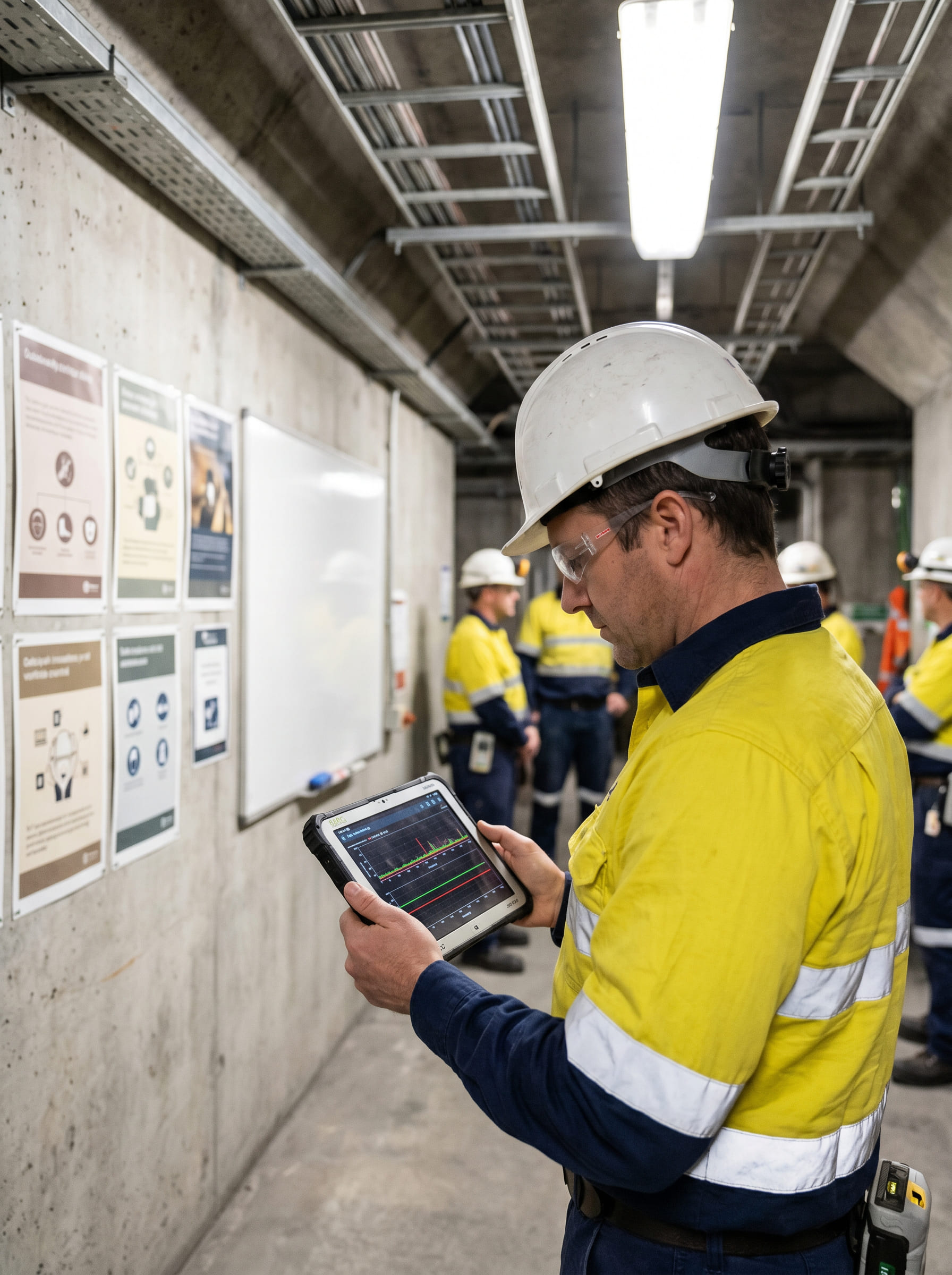
Real-time monitoring changes the equation. Continuous personal dust monitors flag concentration spikes as they happen, giving workers and supervisors the information they need to intervene immediately. NIOSH pilot programs highlighted in recent reporting showed that mines and foundries adopting continuous personal dust monitors cut peak in-shift silica spikes by 72%, virtually eliminating readings above the REL.
How to Detect and Prevent Short-Term Overexposure
Preventing dangerous short-term silica exposure requires a layered approach. No single control is sufficient on its own, especially for high-dust tasks.
Engineering Controls Come First
Wet cutting and wet drilling suppress silica dust at the source, typically reducing airborne concentrations by 80% or more. On-tool local exhaust ventilation (LEV) with HEPA filtration captures dust before it reaches the breathing zone. These aren't optional upgrades. The MSHA silica standard and OSHA's Exposure Control Plans mandate them for high-dust operations.
OSHA compliance audits in 2025 documented that contractors using full Exposure Control Plans drove average shift exposures below 50 µg/m³ RCS and reduced over-exposure citations by 64% versus 2023 baseline data. The evidence is clear: engineering controls work when actually implemented.
Real-Time Monitoring Closes the Gap
You can't fix what you can't see. Real-time dust monitoring tools give safety teams task-level visibility into silica concentrations, replacing end-of-shift averages with continuous, actionable data. Applied Particle Technology's platform pairs real-time dust sensors with intelligent software to flag dangerous spikes during the shift, not days later when a lab report arrives. This approach aligns with the growing industry push toward worker exposure monitoring that captures what actually happens on the ground.
The financial stakes reinforce the urgency. According to OH&S Online, the maximum OSHA penalty for willful or repeated violations now reaches $165,514 per violation. Investing in real-time monitoring and proper controls costs a fraction of a single citation.
What to Do After a Suspected Overexposure
If you believe you've experienced a high-exposure event, don't wait for symptoms. Document the date, task, duration, and conditions. Request a baseline chest X-ray or CT scan and spirometry testing from an occupational health provider. Early detection won't reverse the exposure, but it establishes a medical record and enables monitoring for progression.
Watch for warning signs in the weeks and months that follow: persistent dry cough, unexplained shortness of breath (especially during exertion), chest tightness, and unusual fatigue. These symptoms deserve immediate medical attention, not a "wait and see" approach.
Frequently Asked Questions
Q: What should a job-specific silica exposure control plan include?
A strong plan defines the highest-dust tasks, the exact controls required for each (tools, water delivery, ventilation, containment), and who is responsible for setup and verification. It should also document housekeeping methods, maintenance schedules, and a clear escalation process when conditions change or controls fail.
Q: How can supervisors verify that wet methods and local exhaust ventilation are actually working in the field?
Use a short pre-task checklist: confirm water flow at the point of contact, ensure shrouds are intact and properly seated, and check airflow or suction at the hood. Pair that with routine visual checks (dust plume, slurry control) and periodic performance testing to catch clogged lines, worn seals, or damaged filters.
Q: When is respiratory protection required, and how do you choose the right respirator for silica tasks?
Respiratory protection is needed when engineering and administrative controls cannot reliably keep exposure below the limit or when performing high-dust tasks during setup, cleanup, or unusual conditions. Selection should be based on an exposure assessment and assigned protection factor, then supported by fit testing, a written program, and user training.
Q: What is the difference between an action level and a permissible exposure limit, and why does it matter operationally?
An action level is a proactive trigger for adding controls, increasing monitoring, or starting medical surveillance before you reach the legal limit. Treating action levels as early warning thresholds helps prevent repeated near-misses that can add up to meaningful risk over time.
Q: How should workers safely clean up silica dust without re-suspending it into the air?
Use wet cleanup methods or HEPA-filtered vacuums designed for fine particulates, and avoid dry sweeping or compressed air. Establish designated cleanup procedures, disposal steps, and decontamination practices so dust does not migrate into vehicles, break areas, or homes.
Q: What training topics are most likely to reduce silica risk for new hires and subcontractors?
Effective training focuses on task-specific controls, correct tool setup, housekeeping rules, and what to do when controls are missing or not functioning. It should also cover stop-work authority, how to report exposure concerns, and practical respirator use and limitations.
Q: How can a company reduce take-home exposure to silica dust for workers and their families?
Implement on-site decontamination steps such as changing out of dusty clothing, using dedicated work boots, and cleaning tools with wet or HEPA methods before loading vehicles. Provide clear rules for laundering workwear separately, storing PPE, and keeping dusty items out of personal cars and living spaces.
Every Shift Counts: Protect Your Crew Now
Short-term silica exposure is not a minor inconvenience that gets averaged away on a compliance report. A single uncontrolled shift can deposit enough crystalline silica in your lungs to trigger acute silicosis, a disease with no cure and a grim prognosis. The science, the regulations, and the field data all point to the same conclusion: peak exposure matters more than averages, and real-time visibility is the only way to catch dangerous spikes before they cause lasting damage.
Stop relying on end-of-shift lab results to protect your workers. Applied Particle Technology gives safety teams real-time dust intelligence so you can intervene during the moments that matter, not days after the damage is done. Reach out to see how continuous monitoring fits your operation and keeps your people breathing safely.
Take a tour of APT's dust management platform

Vulcan Materials Company is the nation’s largest producer of construction aggregates.

Project partner
Brent Leclerc | Environmental Manager
Problems solved
Unjustified community dust complaints & lawsuits
Difficulty complying with opacity regulations and risk of NOVs
Solution
Real-time dust monitoring
Dust maps proving no community impact, preventing fines & lawsuits
Real-time opacity monitoring, high degree of compliance


Better decisions start with real-time insight
APT helps industrial teams move faster, act smarter, and stay compliant—because when you can see the problem clearly, you can solve it confidently.
