Permissible exposure limits determine how much of a chemical or dust a worker can breathe over a shift before the exposure becomes legally unacceptable. Yet for any single substance, you might find three different numbers from three different organizations, each with its own legal weight and scientific basis. That disconnect trips up even experienced EHS managers.
The gap between the legal limit and the health-based recommendation can be wide.
For hydrogen fluoride, the OSHA limit sits at 3.0 ppm as an 8-hour average, while the ACGIH threshold limit value is 0.5 ppm. Knowing which number applies, how to look it up, and what to do when monitoring exceeds it is the difference between a compliant program and one that's reacting to citations.
Key Points
OSHA adopted most of its air contaminant limits from science that was already decades old, and a court vacated an attempt to update roughly four hundred limits, leaving many legally enforceable PELs reflecting toxicology from over fifty years ago.
For hydrogen fluoride, the OSHA permissible exposure limit is 3.0 ppm as an 8-hour average while the ACGIH threshold limit value is 0.5 ppm, and although only the PEL carries direct citations, OSHA's General Duty Clause allows the agency to cite employers for recognized hazards even when exposures fall below the PEL but above current science recommendations.
An action level, typically set at half the PEL, triggers obligations such as periodic monitoring and medical surveillance before the full limit is exceeded, because exposure varies shift to shift and a single measurement near the PEL suggests some shifts probably exceed it.
Exposure limits are expressed as 8-hour time-weighted averages that allow short spikes as long as the shift average stays compliant, 15-minute short-term exposure limits that protect against acute effects the TWA would miss, and ceiling values that must never be exceeded at any instant. An employer must comply with all applicable formats simultaneously.
When monitoring shows an exceedance above the PEL, reduce exposures primarily through engineering and work practice controls rather than relying on respirators as a permanent substitute. Notify affected workers, offer medical surveillance at no cost, and repeat monitoring at set intervals until two consecutive measurements at least seven days apart fall below the action level.
What are permissible exposure limits and who sets them
A permissible exposure limit (PEL) is a legally enforceable ceiling on how much of an airborne contaminant a worker may be exposed to during a work shift.
OSHA sets PELs under the authority of the Occupational Safety and Health Act. Once a PEL is published in the Code of Federal Regulations, every covered employer must comply with it.
Most PELs for air contaminants appear in 29 CFR 1910.1000, which covers general industry. Substance-specific standards, such as those for lead and respirable crystalline silica, live in their own regulatory sections under 29 CFR 1910.1001 through 1910.1053 and carry additional requirements beyond the basic limit.
Why many PELs are decades old
OSHA adopted the bulk of its air contaminant tables early in the agency's history, drawing from older ACGIH threshold limit values.
Updating a PEL requires formal rulemaking with public comment periods, economic analysis, and often litigation. The result is that many current PELs reflect science from over fifty years ago.
OSHA attempted a mass update, revising roughly four hundred limits at once. A court vacated most of those updates, pushing many PELs back to their original values.
That history is why the legally enforceable number often lags behind what toxicologists consider protective.
PEL vs. TLV vs. REL: three numbers for one substance
The PEL is OSHA's enforceable limit.
The threshold limit value (TLV) comes from the American Conference of Governmental Industrial Hygienists (ACGIH), a private professional organization that reviews exposure science annually and updates its recommendations without a rulemaking process.
The recommended exposure limit (REL) is published by the National Institute for Occupational Safety and Health (NIOSH), a federal research agency that advises OSHA but cannot enforce its own numbers.
How these limits diverge in practice
Because the ACGIH and NIOSH can move faster than OSHA's rulemaking allows, their values are often more protective.
The hydrogen fluoride example makes this concrete. The OSHA PEL is 3.0 ppm (8-hour TWA), while the NIOSH REL is also 3 ppm but based on a 10-hour workday. The ACGIH publishes four types of TLVs (TWA, STEL, Surface Limit, and Ceiling), with a TWA of 0.5 ppm for hydrogen fluoride.
So which one governs?
The PEL is the only limit that carries direct OSHA citations. But OSHA's General Duty Clause (Section 5(a)(1) of the OSH Act) allows the agency to cite employers for recognized hazards even when no specific PEL exists or when exposures fall below the PEL but above levels that current science considers safe. Courts have upheld General Duty Clause citations based on ACGIH TLVs and NIOSH RELs.
We see this regularly when working with industrial hygiene teams. A substance is "below the PEL" but well above the TLV, and the compliance team isn't sure how to respond.
The safest practice is to treat the most protective of the three values as your operational target. A more detailed comparison of how OSHA and MSHA dust exposure limit standards differ shows why this matters in mining contexts especially.
Action levels: the trigger below the limit
An action level is typically set at half the PEL. When monitoring results reach or exceed the action level, certain employer obligations kick in, even though the full PEL hasn't been exceeded.
Why set a trigger below the limit itself?
Exposure varies from shift to shift. A single measurement near the PEL suggests that some shifts probably exceed it. The action level forces you to start periodic monitoring and employee notification early enough to catch a developing problem before it becomes a violation.
For respirable crystalline silica under 29 CFR 1910.1053, the PEL is 50 µg/m³ and the action level is 25 µg/m³.
Once any employee's exposure hits 25 µg/m³ as an 8-hour TWA, you must begin a schedule of repeated monitoring and offer medical exams. For a deeper look at how silica limits specifically work, the permissible exposure limit for silica page covers that single contaminant in detail.
How exposure limits are expressed: TWA, STEL, and ceiling
Limits describe different timeframes. Understanding the three formats tells you what a given number actually means for a work shift.
The 8-hour time-weighted average
The most common format is the 8-hour TWA. You measure (or calculate) the average airborne concentration a worker breathes over an 8-hour shift.
Short spikes above the limit don't necessarily cause a violation, as long as the math averages out below the PEL across the full 8 hours.
That averaging effect is precisely why the TWA alone isn't enough protection for every substance. A worker could be exposed to a high burst of a fast-acting irritant that causes immediate harm, even though the day's average stays within limits.
Short-term exposure limits
A short-term exposure limit (STEL) caps the average concentration over a 15-minute period. STELs protect against acute effects that a TWA would miss.
Toluene, for example, has a PEL of 200 ppm as a TWA, a ceiling of 300 ppm, and a peak of 500 ppm not to exceed 10 minutes in any 8-hour shift.
Ceiling limits
A ceiling value must never be exceeded at any point during the shift, even instantaneously.
Substances with ceiling limits tend to cause rapid, severe effects at high concentrations. Where OSHA publishes a ceiling for a substance, any single measurement above that number is a violation, regardless of the shift average.
How do these formats interact during a single shift?
Think of it as layered protection. The TWA guards against cumulative daily dose. The STEL guards against dangerous 15-minute bursts. The ceiling guards against any instantaneous spike.
You must comply with all applicable limits simultaneously.
Where to look up a published limit
The OSHA air contaminant tables in 29 CFR 1910.1000 are organized into three tables.
Table Z-1 lists limits for most regulated substances alphabetically by chemical name, giving PELs as 8-hour TWAs and, where applicable, ceiling values. Table Z-2 covers a smaller set of substances with more complex limit structures, including TWAs and acceptable maximum peaks. Table Z-3 addresses mineral dusts.
You can read all three tables as fetchable HTML through the Cornell Law Institute's CFR mirror at 29 CFR 1910.1000.
Substance-specific standards (silica, lead, cadmium, and others) are not in these tables. They live in their own sections and include additional obligations beyond the limit itself.
When you look up a substance, note the units. Limits for gases and vapors are usually in parts per million (ppm). Limits for dusts and particulates are in milligrams per cubic meter (mg/m³) or micrograms per cubic meter (µg/m³).
Comparing across substances means paying attention to those units.
Exposure monitoring: determining whether your workplace exceeds a limit
Knowing the published number is only half the equation. You also need to know what your workers are actually breathing.
Personal air sampling
The standard method is personal air sampling.
A pump worn by the worker draws air through a collection medium (a filter cassette or sorbent tube) at a calibrated flow rate for a measured period, typically the full shift. A laboratory then analyzes the sample and reports the concentration. That result is compared to the PEL.
OSHA's substance-specific standards spell out sampling protocols. For silica, you must collect samples representative of each employee's full-shift exposure and analyze them using an approved method.
Real-time monitoring as a complement
Traditional sampling tells you what happened after the lab returns results, sometimes weeks later.
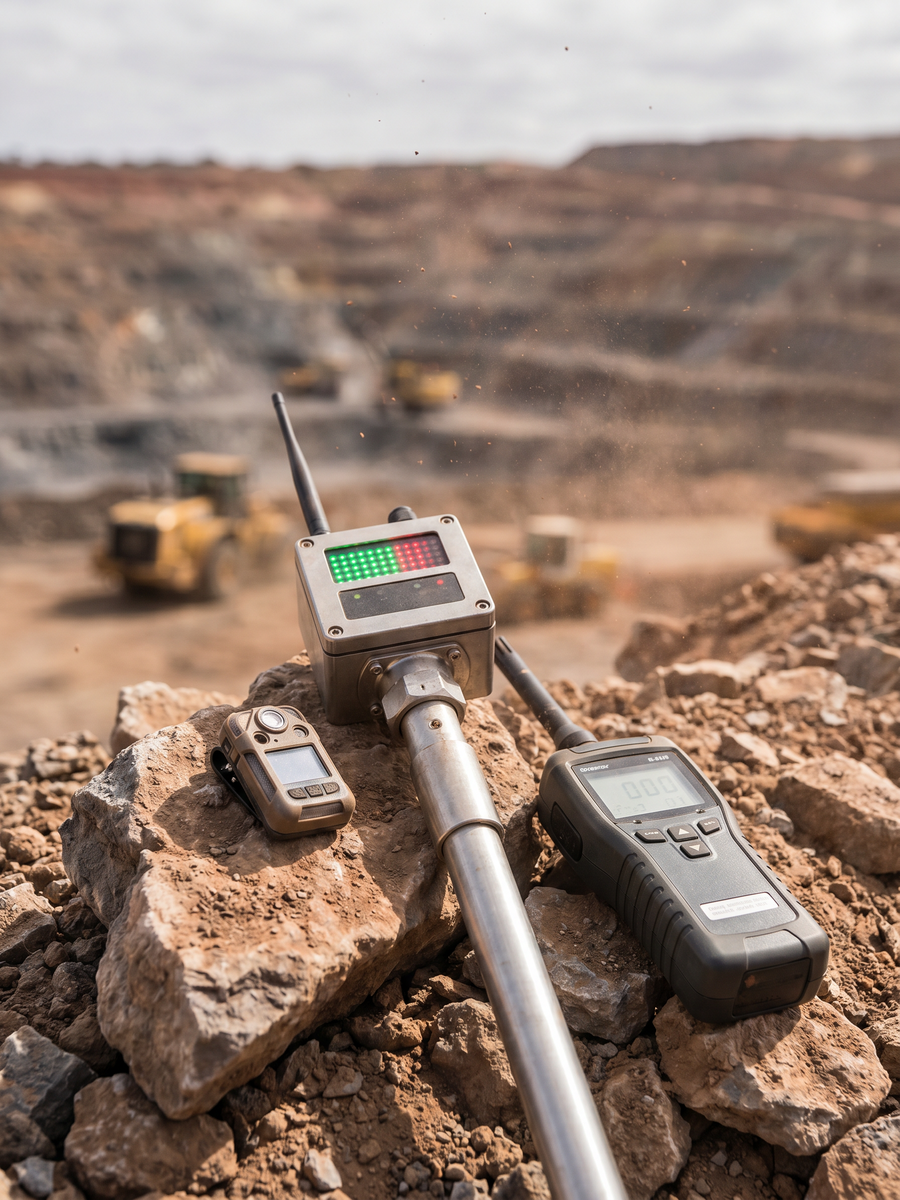
Real-time dust monitors fill that gap by reporting concentration data continuously throughout the shift. They don't replace the gravimetric sample for regulatory compliance in most cases, but they help you identify which tasks and time windows drive the highest exposures.
Applied Particle Technology combines real-time dust sensors with analytical software to give EHS teams that shift-level visibility. Continuous data lets you correlate spikes with specific activities, so engineering controls target the actual source rather than a general area.
If you're building a worker dust exposure monitoring program, pairing traditional sampling with real-time instruments gives you both the legally defensible record and the operational insight to reduce exposures proactively.
What happens when monitoring shows an exceedance
An exposure above the PEL triggers a regulatory response chain, and the obligations escalate quickly.
Immediate corrective action
You must reduce exposures below the PEL, primarily through engineering and work practice controls.
Respiratory protection may serve as an interim measure while those controls are implemented, but OSHA does not accept respirators as a permanent substitute for feasible engineering fixes.
Employee notification and medical surveillance
Workers exposed above the action level or PEL must be notified of their monitoring results.
Under most substance-specific standards, you must also offer medical surveillance at no cost to the employee. For lead, that means blood lead level testing. For silica, it includes chest X-rays and pulmonary function tests along with a health questionnaire.
You must maintain exposure and medical records for the periods specified in the applicable standard. Silica records, for example, must be kept for 30 years.
Repeat monitoring and documentation
After implementing controls, repeat monitoring to confirm exposures have dropped below the PEL.
Many standards require monitoring at set intervals (every three or six months) as long as exposures remain above the action level. Only when two consecutive measurements at least seven days apart fall below the action level can you typically stop periodic monitoring.
Documentation matters here.
An OSHA inspector will want to see your sampling data, your written exposure control plan, and evidence that you acted on the results. An exposure control plan template can help structure this documentation. The written record is your defense.
Frequently asked questions
Which exposure limit should I use if my facility operates outside the United States?
Start with your local regulator's occupational exposure limits, then compare them to globally recognized guidance such as ACGIH TLVs and NIOSH recommendations. Multinational employers often standardize on the most protective value that is feasible to implement across sites, then document any country-specific exceptions.
How do I handle mixtures of chemicals when each component has its own limit?
For additive effects, industrial hygienists often use a mixture formula that evaluates the combined fraction of each component's exposure relative to its limit. If chemicals have different target organs or uncertain interactions, treat the assessment more conservatively and consider task-based controls and substitution reviews.
Do permissible exposure limits apply to skin contact or only inhalation?
Many limits are airborne only, but some substances have "skin" notations indicating significant absorption through skin or eye contact. In those cases, your control strategy should include dermal protection and hygiene practices along with targeted training.
What is the difference between an exposure limit and an IDLH value?
Exposure limits are designed for routine occupational conditions over defined timeframes, while IDLH (Immediately Dangerous to Life or Health) values guide emergency planning and respirator selection for high-risk situations.
IDLH is especially relevant for confined spaces, spill response, and scenarios where rapid incapacitation is possible.
How do I convert between ppm and mg/m³ when comparing references?
You can convert gases and vapors using the substance's molecular weight and the temperature and pressure assumptions behind the reference value. Because conditions matter, use a standard conversion calculator or IH software and cite the assumptions in your documentation to avoid apples-to-oranges comparisons.
What should I do when laboratory results come back as "non-detect"?
"Non-detect" does not mean zero. It means the result is below the method's reporting limit.
Ask for the method detection limit, reporting limit, and sampling volume, then evaluate whether the method was sensitive enough to effectively compare against your chosen target.
How can I prioritize controls when I have multiple overexposures across different tasks?
Rank tasks by risk using severity, frequency, and how far results are from your internal target. Pair that with feasibility and time-to-implement, then use a control roadmap (engineering first, administrative next, PPE last) to drive measurable reductions quickly.
Build your exposure program around the most protective number
Permissible exposure limits are the legal floor. The smartest industrial hygiene programs we've worked with treat ACGIH TLVs or NIOSH RELs as their operational targets and use PELs as the line that must never be crossed.
That approach protects workers against hazards the older limits weren't designed to address, and it gives you a compliance margin that absorbs normal shift-to-shift variability.
Whether you're managing silica in a mine, toluene in a coating operation, or lead in a battery plant, the fundamentals stay the same. Know which limits apply, monitor against them, act on the results, and document everything.
Applied Particle Technology helps EHS and industrial hygiene teams close the gap between sampling events with continuous, real-time dust monitoring. If you want to see how shift-level exposure data changes the way you respond to exceedances, book a personalized demo and we'll walk through your operation together.
Take a tour of APT's dust management platform

Vulcan Materials Company is the nation’s largest producer of construction aggregates.

Project partner
Brent Leclerc | Environmental Manager
Problems solved
Unjustified community dust complaints & lawsuits
Difficulty complying with opacity regulations and risk of NOVs
Solution
Real-time dust monitoring
Dust maps proving no community impact, preventing fines & lawsuits
Real-time opacity monitoring, high degree of compliance




Better decisions start with real-time insight
APT helps industrial teams move faster, act smarter, and stay compliant—because when you can see the problem clearly, you can solve it confidently.
