Crystalline silica kills at a scale most safety professionals underestimate, and the reason comes down to something invisible to the naked eye: atomic arrangement. Two dust samples can contain the same silicon dioxide concentration, yet one carries a Group 1 carcinogen classification while the other does not. The difference is whether those silicon and oxygen atoms lock into a repeating lattice or tumble into a disordered network.
That distinction matters enormously for anyone managing worker health in mining, construction, or heavy manufacturing. Measuring "total dust" or relying on an area monitor mounted on a wall will not tell you whether the respirable fraction reaching a worker's breathing zone contains the crystalline form. This article explains the science behind the two silica types, walks through the toxicological mechanism that makes crystalline silica so dangerous, and shows why sampling strategy determines whether you catch the real hazard or miss it entirely.
What Is Crystalline Silica and Where Does It Appear?
Silicon dioxide (SiO₂) is the second most abundant mineral in Earth's crust. Crystalline silica refers to forms of SiO₂ in which atoms arrange themselves in a fixed, repeating three-dimensional lattice. The three principal polymorphs are quartz, cristobalite, and tridymite. Quartz dominates in natural deposits and processed materials. Cristobalite and tridymite form at higher temperatures, which is why they show up in volcanic rock, refractory linings, and materials that have been through sustained heating such as calcining or kiln firing.
Workers encounter crystalline silica wherever rock, sand, or concrete is cut, drilled, crushed, or ground. That includes hard-rock and sand mining, tunneling, concrete sawing, engineered-stone fabrication, foundry work, and demolition. NIOSH identifies the respirable fraction of crystalline silica as the primary driver of occupational lung disease, including silicosis and lung cancer. The hazard is not the bulk material sitting in a pile. It is the fine particles, roughly 4 micrometers and smaller, generated when that material is mechanically disturbed and inhaled deep into the alveolar region of the lung.
Crystalline Silica vs Amorphous Silica: Structural and Toxicological Differences
Atomic Structure Defines the Hazard
Amorphous silica contains the same SiO₂ formula, but its atoms lack long-range order. Think of it as a frozen liquid: the building blocks are the same, but they never settle into a repeating pattern. Diatomaceous earth, fumed silica, precipitated silica, and silica gel are all amorphous forms. They appear across food processing, filtration, coatings, and pharmaceutical manufacturing.
The ordered lattice in crystalline silica is what makes it biologically destructive. When a respirable quartz particle deposits in the alveolar region, its surface generates reactive oxygen species that damage cell membranes and DNA. Alveolar macrophages engulf the particle but cannot dissolve it. The macrophage dies, releasing inflammatory cytokines and the intact particle, which triggers another macrophage to attempt the same futile cycle. Over months and years, this persistent inflammation leads to fibrosis (silicosis) and, in many cases, malignant transformation.
Amorphous silica particles generally do not trigger that same persistent inflammatory loop. They are more readily cleared from lung tissue and do not carry the carcinogen classification. However, amorphous silica is not universally benign. When heated above roughly 1,470 °F (800 °C) for sustained periods, amorphous silica can convert to cristobalite. Calcining operations, ceramic kilns, and refractory maintenance are contexts where this conversion is a real concern. Anyone managing dust in those environments needs to verify what polymorph they are actually dealing with, not assume the starting feedstock tells the whole story.
Side-by-Side Comparison
- Property: Atomic structure | Crystalline Silica (Quartz, Cristobalite, Tridymite): Ordered, repeating lattice | Amorphous Silica: Disordered, no long-range order
- Property: Common sources | Crystalline Silica (Quartz, Cristobalite, Tridymite): Sandstone, granite, concrete, engineered stone, sand | Amorphous Silica: Diatomaceous earth, fumed silica, silica gel, volcanic glass
- Property: Cancer classification | Crystalline Silica (Quartz, Cristobalite, Tridymite): IARC Group 1 carcinogen (respirable fraction) | Amorphous Silica: IARC Group 3 (not classifiable as carcinogenic)
- Property: Primary health hazard | Crystalline Silica (Quartz, Cristobalite, Tridymite): Silicosis, lung cancer, COPD, kidney disease, autoimmune effects | Amorphous Silica: Mild irritation at high concentrations; generally lower toxicity
- Property: Conversion risk | Crystalline Silica (Quartz, Cristobalite, Tridymite): Stable under ambient conditions | Amorphous Silica: Converts to cristobalite under sustained high heat (calcining, kiln firing)
- Property: NIOSH analytical method | Crystalline Silica (Quartz, Cristobalite, Tridymite): NMAM 7500 (XRD) or NMAM 7602 (IR) on respirable fraction | Amorphous Silica: Typically total-dust gravimetric; no specific polymorph ID needed unless conversion suspected
- Property: Regulatory PEL (OSHA/MSHA) | Crystalline Silica (Quartz, Cristobalite, Tridymite): 50 µg/m³ (8-hr TWA, respirable fraction) | Amorphous Silica: No specific crystalline silica PEL; general dust limits apply
The International Agency for Research on Cancer classifies respirable crystalline silica (quartz and cristobalite) as a Group 1 carcinogen, meaning sufficient evidence exists that it causes cancer in humans. That classification applies specifically to the respirable fraction, the particles small enough to reach the gas-exchange region of the lung. Larger particles deposit in the upper airways and are cleared by mucociliary transport before they can cause the alveolar damage that leads to silicosis or malignancy.
Why Respirable Fraction Measurement Matters More Than Bulk Dust
How NIOSH Analytical Methods Identify Crystalline Silica
Regulatory sampling for crystalline silica follows a specific two-step process. First, a size-selective cyclone sampler collects only particles roughly 4 micrometers and smaller onto a filter. Then the filter goes to a laboratory for analysis by either X-ray diffraction (NIOSH NMAM 7500) or infrared spectrophotometry (NMAM 7602). XRD identifies quartz, cristobalite, and tridymite by their characteristic diffraction peaks. IR measures absorption bands specific to the crystalline lattice.
Both methods require the respirable fraction to be isolated before analysis. A total-dust sample or an area grab will not give you a valid crystalline silica result under either OSHA or MSHA standards. OSHA's permissible exposure limit of 50 µg/m³ and action level of 25 µg/m³ apply to an 8-hour time-weighted average of the respirable fraction collected in a worker's breathing zone. MSHA's 2024 silica rule aligns to the same PEL and action level for metal/nonmetal mining operations now in effect.
Area Readings and Bulk Dust Can Point You at the Wrong Place
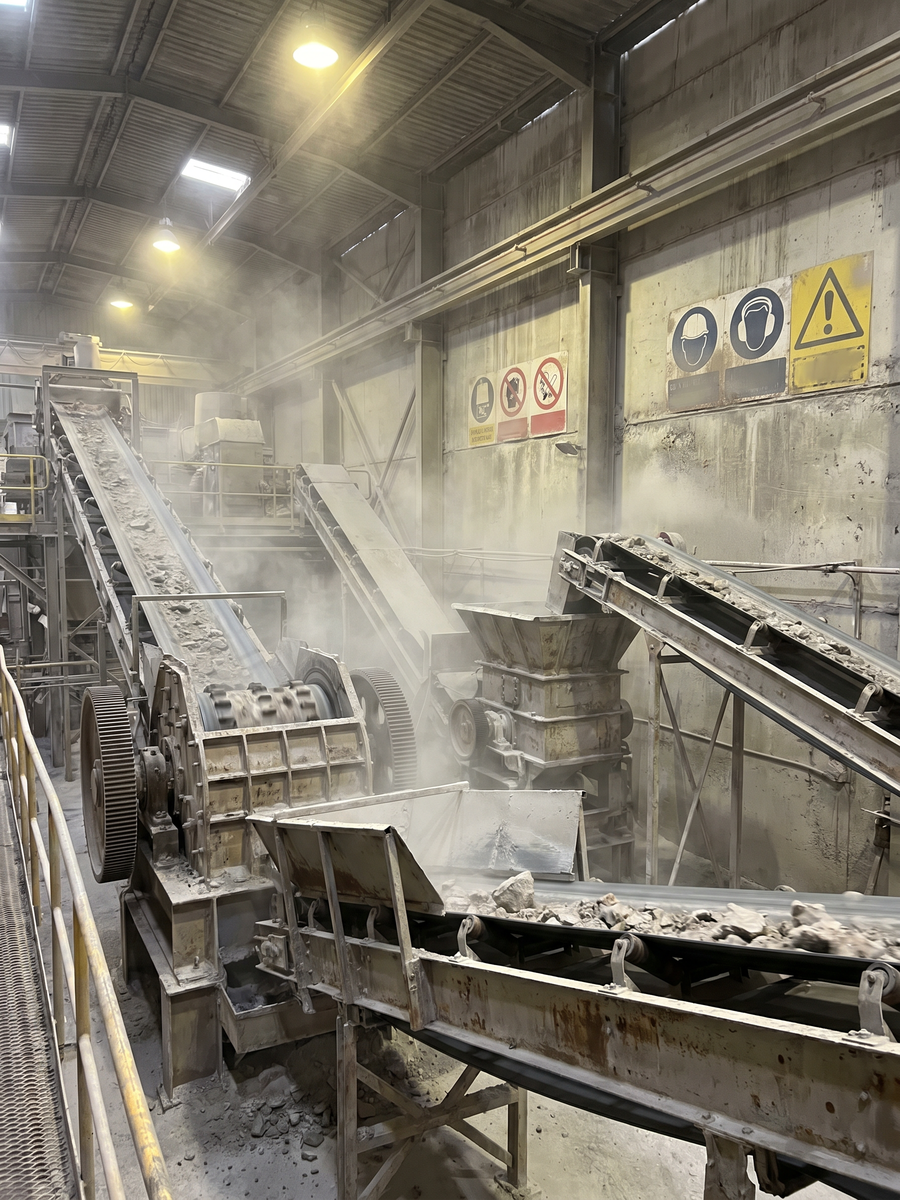
A single proof point from an iron-ore processing operation illustrates the gap between area dust data and actual worker exposure. The dustiest area reading at that site was a primary crusher running at 10.7 times the action level and over the PEL 89 percent of the time. On paper, that looked like the most dangerous location on site.
It was not where the overexposed workers were. Crusher operators sat in enclosed, filtered cabs that brought their personal breathing-zone concentrations well below concern. The actual overexposures clustered in a separate building that read just under the limit as an area average. Workers there moved through zones of variable concentration, and their cumulative personal exposure exceeded limits that the area monitor never flagged.
This pattern repeats across operations. Area monitors measure a fixed point. Workers move. They lean over conveyors, open inspection doors, walk through plumes. Their breathing-zone exposure can differ by an order of magnitude from what a wall-mounted sensor reports for the same room. Building a silica control program on area or bulk dust readings alone is building on the wrong foundation. Understanding how respirable crystalline silica behaves in real work environments requires personal, task-level data.
Bridging the Data Gap with Real-Time Monitoring
Traditional filter-based sampling tells you what happened over an entire shift, but it cannot tell you when or during which task the exposure spike occurred. If a worker's 8-hour TWA comes back above the action level, you know there is a problem, but you are left guessing which 20-minute window drove the result. That guessing game slows down control verification and wastes engineering resources on the wrong source.
Real-time dust monitoring with respirable-fraction sensors changes the feedback loop. Continuous concentration data, paired with task logs or location tracking, isolates which activities and locations contribute the most to a worker's cumulative dose. A federally funded research study that deployed APT dust sensors, conducted in collaboration with NIOSH researchers, demonstrated that continuous real-time particulate data from personal and area sensors can identify dust events at high spatial and temporal resolution.
The practical payoff is faster, more targeted intervention. Instead of resampling an entire workforce after every engineering change, teams can use the continuous data stream to confirm whether a control, such as improved ventilation or cabin pressurization, actually reduced the respirable fraction in the breathing zone. That distinction between real-time and filter-based approaches determines how quickly you close the loop on a silica overexposure.
Reducing Exposure Where Crystalline Silica Hazards Concentrate
Effective silica control follows the hierarchy of controls, but the starting point is always the same: identify where the respirable crystalline silica actually concentrates in a worker's shift. Wet suppression, local exhaust ventilation, enclosed cabs with positive-pressure filtration, and administrative rotation all have roles. None of them work well if applied to the wrong location or wrong task.
Enclosed operator cabs are a good example of a control that works brilliantly when maintained and misleads when it is not. The iron-ore case above showed cabs protecting crusher operators despite extreme ambient dust. But cab seal integrity degrades between maintenance cycles. A cracked door seal or a clogged intake filter can turn a protective enclosure into a concentrator that traps fine particles inside. Continuous personal sampling catches those failures in real time rather than on the next quarterly lab report.
For operations where amorphous silica feedstock undergoes thermal processing, the control strategy must also account for phase conversion. Post-calcining dust may contain cristobalite even if the raw feed was entirely amorphous. XRD analysis of the respirable fraction from the downstream process, not just the input material, is the only way to confirm whether the crystalline form is present.
Frequently Asked Questions
Q: How can I tell if a lab is qualified to analyze respirable crystalline silica samples?
A: Ask whether the lab participates in an accredited proficiency testing program and has documented quality controls for silica methods. You should also confirm they can report separate results for quartz and cristobalite when applicable and provide clear limits of detection and quantitation.
Q: What documentation should I keep to make silica sampling results defensible during an audit or inspection?
A: Maintain a complete chain of custody, calibration records for sampling pumps, sampler IDs, and field notes that capture tasks, locations, PPE, and control conditions. Clear documentation helps you explain why results changed over time and supports follow-up actions.
Q: How often should we repeat silica monitoring if processes, materials, or controls change?
A: Reassess whenever there is a meaningful change such as new tooling, production rate shifts, altered ventilation, or a different material supplier. Many teams also set a routine cadence based on risk, then add event-based sampling after changes to confirm exposures remain controlled.
Q: How do I prioritize which tasks to evaluate first when we have limited sampling budget?
A: Start with tasks that have the highest dust generation potential, longest duration, or highest worker proximity to disturbance, then validate with a small number of representative shifts. Pair this with input from supervisors and workers to identify non-obvious high exposure moments like cleanups, maintenance, and startup or shutdown work.
Q: What mistakes commonly cause misleading silica results even when the right analytical method is used?
A: Common issues include poor pump calibration, incorrect cyclone flow rate, damaged filters, or sampling that does not reflect normal work practices. Another frequent problem is failing to capture enough representative shifts or job roles, which can hide variability between workers doing similar work.
Q: How should PPE decisions be made alongside engineering controls for silica exposure?
A: Use PPE as a complement to engineering and administrative controls, not a substitute, and base respirator selection on measured exposure levels and the assigned protection factor required. A written respiratory protection program, fit testing, and training are essential to ensure real-world protection matches the plan.
Q: What should we do if we suspect cristobalite formation after thermal processing but do not have historical data?
A: Treat it as a verification problem, map the process steps where high heat is applied, then sample the post-heat tasks and nearby cleanup activities first. In parallel, review temperatures, residence times, and maintenance records to narrow likely sources and prioritize the highest-impact locations for testing.
The Measurement You Choose Defines the Risk You See
The difference between crystalline silica and amorphous silica is written into their atomic structure, and that structure determines everything: toxicity, regulatory classification, analytical method, and the health consequences for the people breathing the dust. Bulk concentration, total-dust readings, and area averages all obscure the variable that matters most, which is the mass of respirable crystalline silica entering a specific worker's lungs during a specific task.
Programs that treat all silica dust the same, or that rely on fixed-point monitors to characterize personal exposure, will consistently misallocate resources. The data from the iron-ore operation proves it: the loudest reading was not the real problem, and the real problem barely registered on the area monitor.
If your operation generates silica dust in any form, the next step is confirming that your monitoring program captures the respirable fraction, identifies the crystalline polymorph, and ties results to individual workers and tasks. Book a personalized demo to see how continuous, worker-level dust data closes the gap between what your area monitors report and what your people actually breathe.
Take a tour of APT's dust management platform

Vulcan Materials Company is the nation’s largest producer of construction aggregates.

Project partner
Brent Leclerc | Environmental Manager
Problems solved
Unjustified community dust complaints & lawsuits
Difficulty complying with opacity regulations and risk of NOVs
Solution
Real-time dust monitoring
Dust maps proving no community impact, preventing fines & lawsuits
Real-time opacity monitoring, high degree of compliance



Better decisions start with real-time insight
APT helps industrial teams move faster, act smarter, and stay compliant—because when you can see the problem clearly, you can solve it confidently.
