The OSHA PEL for respirable dust sits at 5 mg/m³, a number most safety managers can recite from memory. Yet knowing the limit and actually staying below it are two very different problems, especially when crystalline silica, coal dust, and nuisance particulates all carry their own thresholds across overlapping regulatory frameworks.
This quick reference guide pulls OSHA, MSHA, NIOSH, and ACGIH limits into one place so you can stop toggling between government PDFs. You'll find the current exposure limits, how they compare, when action levels kick in, and what each number means for your monitoring program.
What Is a PEL?
A Permissible Exposure Limit (PEL) is the maximum concentration of a substance in workplace air that an employee can legally be exposed to over an 8-hour time-weighted average (TWA). OSHA establishes PELs under the authority of the Occupational Safety and Health Act, and employers must keep exposures at or below these values.
PELs apply to the breathing zone of the worker, not to general area readings. That distinction matters. A facility can have acceptable ambient air quality and still have individual workers exceeding the PEL based on their specific tasks and proximity to dust sources.
PEL vs. REL vs. TLV
You'll encounter three acronyms repeatedly in dust compliance. OSHA PELs are legally enforceable. NIOSH Recommended Exposure Limits (RELs) are science-based guidelines without direct enforcement power. ACGIH Threshold Limit Values (TLVs) are consensus recommendations from an independent professional organization. Many NIOSH RELs and ACGIH TLVs are more protective than OSHA PELs because OSHA's rulemaking process is slower to update.
OSHA PEL for Respirable Dust (PNOR)
Particulates Not Otherwise Regulated (PNOR) is the category OSHA uses for dusts that don't have a substance-specific standard. The OSHA PEL for respirable dust classified as PNOR is 5 mg/m³ as an 8-hour TWA. The total dust PEL for the same category is 15 mg/m³.
"Respirable" refers to particles small enough to reach the gas-exchange region of the lungs, generally those below 4 micrometers in aerodynamic diameter. Total dust includes all inhalable particles regardless of size.
One important caveat: PNOR limits assume the dust is relatively inert. If the material contains even a small percentage of crystalline silica, the silica-specific standard applies instead, and the allowable concentration drops dramatically.
OSHA PEL for Respirable Crystalline Silica
Crystalline silica gets its own standard because it causes silicosis, lung cancer, and chronic obstructive pulmonary disease. Under 29 CFR 1910.1053 (general industry) and 29 CFR 1926.1153 (construction), OSHA sets the PEL at 50 µg/m³ as an 8-hour TWA. That's 100 times lower than the PNOR respirable dust limit.
The regulation also defines an action level of 25 µg/m³. Once exposures reach or exceed that action level, employers must initiate exposure monitoring, medical surveillance, and other compliance obligations. According to a study published in the Annals of Work Exposures and Health, 53% of air samples collected in engineered-stone fabrication shops during 2025 exceeded OSHA's crystalline silica PEL. Real-world compliance gaps remain significant.
Construction Table 1 Controls
For construction employers, OSHA's Table 1 offers a practical shortcut. It lists specific tasks (cutting, grinding, drilling) along with required engineering controls and respiratory protection for each. Employers who fully implement Table 1 controls don't need to perform air monitoring for those tasks. According to OSHA's compliance guidance, field audits confirm task-based exposures drop below 50 µg/m³ when water delivery and HEPA-vac systems are properly implemented.
Effective worker exposure monitoring remains the backbone of compliance for tasks not covered by Table 1, or when an employer wants to verify that controls are working as expected.
MSHA Respirable Dust Standards
MSHA operates independently from OSHA and sets its own dust limits for mining operations. For coal mines, the respirable dust standard is 1.5 mg/m³ as an 8-hour TWA. Metal and nonmetal mines follow a different structure that factors in the silica content of the dust.
When quartz content exceeds certain thresholds in metal/nonmetal operations, MSHA applies a formula-based reduced standard rather than a single fixed number. Understanding the latest MSHA silica standard is essential for any mining operation handling silica-bearing rock.
Recent MSHA Silica Rule Updates
MSHA has been tightening silica enforcement, and the MSHA silica rule changes affect sampling frequency, corrective action timelines, and citation thresholds. Mining operators who only track OSHA limits may find themselves out of compliance with MSHA's more aggressive enforcement posture.
NIOSH RELs
NIOSH recommends an REL of 50 µg/m³ for respirable crystalline silica, which matches OSHA's current PEL. For respirable dust (PNOR equivalent), the NIOSH REL is generally more conservative at lower concentrations over longer exposure windows.
NIOSH recommendations carry weight even without legal enforcement. Courts and insurance carriers reference RELs when evaluating whether an employer exercised reasonable care. A company meeting the PEL but ignoring a significantly lower REL may face liability challenges. NIOSH has also been actively deploying field research, including studies where NIOSH deployed real-time dust sensors to evaluate silica monitoring approaches in operational mining environments.
ACGIH TLVs
The ACGIH sets a TLV of 0.025 mg/m³ (25 µg/m³) for respirable crystalline silica, which is half the OSHA PEL. For respirable particles (insoluble or poorly soluble), the ACGIH TLV is 3 mg/m³, lower than OSHA's 5 mg/m³ PNOR limit.
These TLVs represent what the ACGIH considers protective for nearly all workers under normal conditions. Some companies adopt ACGIH TLVs as internal targets even though they aren't legally required to do so. It's a defensible strategy, especially for operations with long-term workforce exposure.
Respirable Dust Limits: Side-by-Side Comparison
The table below consolidates the major exposure limits you'll reference most frequently. All values represent 8-hour TWAs unless noted otherwise.
- Substance / Category: Respirable Dust (PNOR) | OSHA PEL: 5 mg/m³ | MSHA Standard: Varies by mine type | NIOSH REL: — | ACGIH TLV: 3 mg/m³
- Substance / Category: Total Dust (PNOR) | OSHA PEL: 15 mg/m³ | MSHA Standard: — | NIOSH REL: — | ACGIH TLV: 10 mg/m³
- Substance / Category: Respirable Crystalline Silica | OSHA PEL: 50 µg/m³ | MSHA Standard: Formula-based (M/NM); varies (coal) | NIOSH REL: 50 µg/m³ | ACGIH TLV: 25 µg/m³
- Substance / Category: Respirable Coal Mine Dust | OSHA PEL: — | MSHA Standard: 1.5 mg/m³ | NIOSH REL: 1.0 mg/m³ | ACGIH TLV: —
Action Levels and Compliance Triggers
Action levels exist to catch problems before they become violations. For respirable crystalline silica, OSHA's action level of 25 µg/m³ triggers a cascade of employer obligations: initial and periodic exposure assessments, written exposure control plans, medical surveillance, and employee training.
What Happens When You Hit 25 µg/m³
Once any employee's exposure reaches or exceeds the action level, the employer must conduct further monitoring to characterize the exposure. If levels remain above the action level, monitoring continues at regular intervals. If exposures exceed the PEL of 50 µg/m³, the employer must immediately implement additional controls and provide respiratory protection while those controls take effect.
Strategies for reducing silica exposure typically combine wet suppression, ventilation, enclosure, and administrative scheduling. The most effective programs layer multiple controls rather than relying on a single measure.
Why Shift-Level Data Isn't Enough
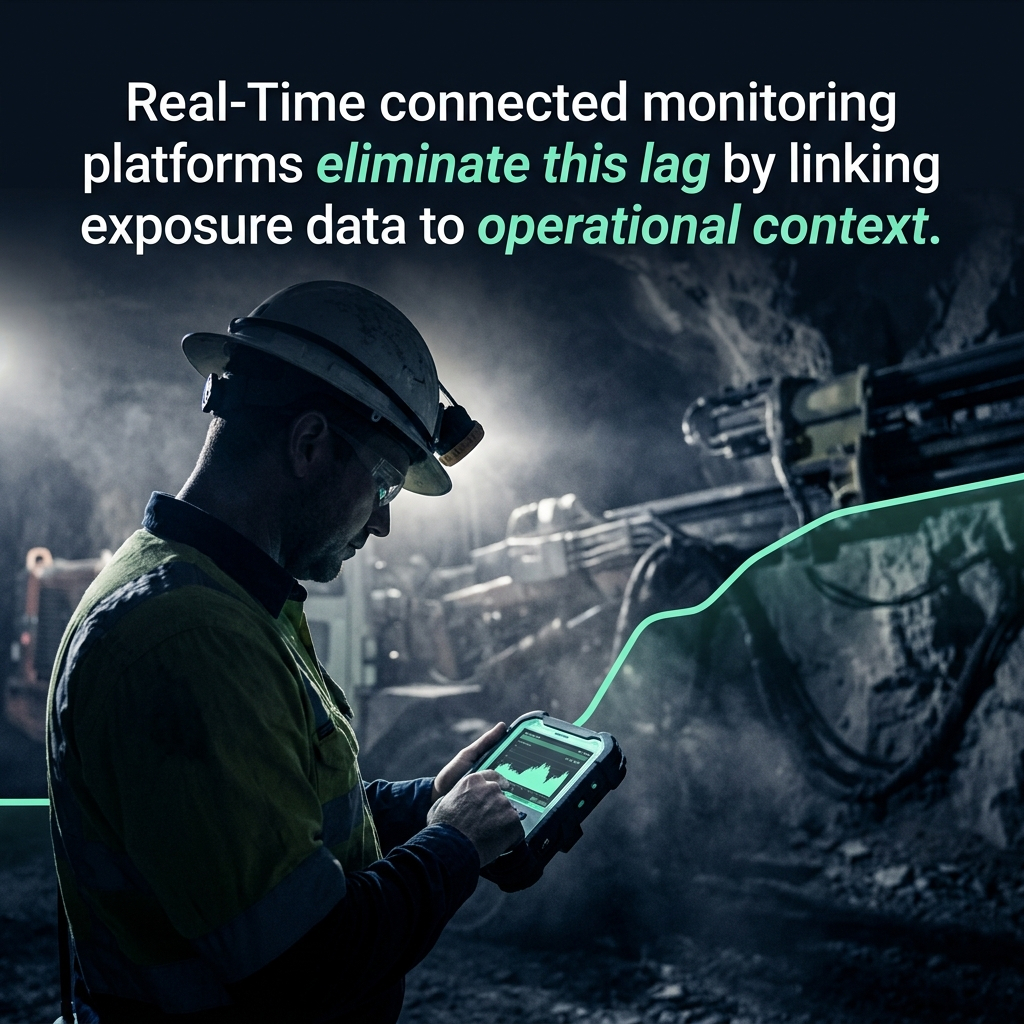
Traditional filter-based sampling gives you an 8-hour average, but peak exposures during specific tasks can be several times the PEL even when the shift average looks acceptable. Real-time dust monitoring fills that gap by identifying exactly when and where exposures spike, enabling targeted corrections based on real-time data rather than waiting days or weeks for lab results.
Frequently Asked Questions
How do I calculate an 8-hour TWA if a worker does multiple dusty tasks in one shift?
Break the shift into time segments, estimate or measure the average exposure for each segment, then compute a time-weighted average based on hours at each level. If you do not have segment data, use personal sampling or real-time logging to avoid relying on assumptions.
What documentation should we keep to be audit-ready for a respirable dust inspection?
Maintain sampling plans, calibration and chain-of-custody records, lab reports, exposure assessment summaries, and evidence of control maintenance (ventilation checks, filter changes, water flow logs). Also keep training records, respirator program documents (when applicable), and corrective action notes tied to specific dates and tasks.
How often should respirable dust monitoring be repeated in a stable operation?
A practical approach is to monitor more frequently after process changes, new materials, new equipment, or control modifications, then reduce frequency once results show consistent control. Many programs also schedule periodic verification sampling to confirm conditions have not drifted over time.
How can we screen for silica content in a dust before choosing the right sampling strategy?
Review Safety Data Sheets, supplier specs, and process inputs, then validate with bulk material testing when the source is uncertain or variable. If silica is plausible, plan sampling that can quantify crystalline silica specifically rather than treating the dust as a generic category.
What is the difference between personal sampling results and area monitoring, and when should each be used?
Personal sampling estimates what an individual actually inhales, which is typically the basis for exposure compliance decisions. Area monitoring helps map sources, evaluate controls, and locate hotspots, but it should not be used as a substitute for worker exposure measurements when making compliance determinations.
What are common mistakes that cause respirable dust data to be unreliable?
Frequent issues include incorrect flow rates, poor cyclone or cassette placement, clogged inlets, short sampling durations that miss task variability, and incomplete field notes about tasks and controls. Implementing standardized procedures and routine QA checks greatly improves data defensibility.
How should we prioritize engineering controls versus respirators in a long-term dust reduction plan?
Use the hierarchy of controls, focus first on source reduction and capture (process changes, local exhaust, isolation), then use respirators as a supplemental layer when residual risk remains. A clear plan links each high-exposure task to a control owner, maintenance cadence, and a measurable performance check.
Build a Dust Compliance Program That Holds Up
Knowing the OSHA PEL for respirable dust is the starting point, not the finish line. Effective compliance requires understanding how OSHA, MSHA, NIOSH, and ACGIH standards interact, where your site-specific exposures actually land, and how to close gaps before an inspector finds them.
The numbers in this guide don't change often, but enforcement priorities and monitoring technology do. Organizations that invest in continuous exposure data, rather than periodic grab samples, position themselves to respond faster and document compliance more defensibly.
Applied Particle Technology combines real-time dust sensors with intelligent software to give safety teams the actionable data they need. If you're ready to move beyond spreadsheets and lab delays, explore how APT's dust management platform helps industrial operations stay ahead of every limit on this page.
Take a tour of APT's dust management platform

Vulcan Materials Company is the nation’s largest producer of construction aggregates.

Project partner
Brent Leclerc | Environmental Manager
Problems solved
Unjustified community dust complaints & lawsuits
Difficulty complying with opacity regulations and risk of NOVs
Solution
Real-time dust monitoring
Dust maps proving no community impact, preventing fines & lawsuits
Real-time opacity monitoring, high degree of compliance


.png)

Better decisions start with real-time insight
APT helps industrial teams move faster, act smarter, and stay compliant—because when you can see the problem clearly, you can solve it confidently.
