The MSHA silica rule is in legal limbo, and mining operations are caught between a court order, an indefinite agency delay, and exposure risks that do not pause for litigation. If your compliance team is unsure what to enforce right now, you are far from alone.
A PubMed-indexed study spanning 20 years of U.S. mining data found that 11.8% of respirable crystalline silica samples exceeded the MSHA permissible exposure limit, with annual exceedance ranging from 6.9% to 17.3%. The hazard is real whether or not the new rule's deadlines hold.
This guide covers what is paused, what remains enforceable today, and the practical steps you should take to manage exposure risk and stay inspection-ready during the delay. By the end, you will know exactly which duties apply to your site right now and how to build a control program that holds up regardless of where the MSHA silica rule lawsuit lands.
What Is the MSHA Silica Rule?
The MSHA silica rule is a federal regulation issued in 2024 by the Mine Safety and Health Administration to lower permissible exposure to respirable crystalline silica in both coal and metal/nonmetal (MNM) mines. Silica dust, generated during drilling, blasting, and crushing, causes silicosis, lung cancer, and other irreversible respiratory diseases when inhaled at elevated concentrations over time.
Before the 2024 rule, coal and MNM mines operated under separate, older exposure standards that had not been updated in decades. The new rule was designed to unify these limits and bring them closer to the thresholds OSHA already enforces in general industry and construction.
Why a Unified Standard Matters
Operating under two different frameworks created inconsistency. A miner doing similar work in a coal operation faced different regulatory benchmarks than a miner in a sand-and-gravel pit. The 2024 rule aimed to close that gap with a single set of requirements across all mine types.
Understanding how OSHA and MSHA dust exposure limits compare helps you see why regulators pushed to align them.
What Does the MSHA Silica Rule Require From Mine Operators?
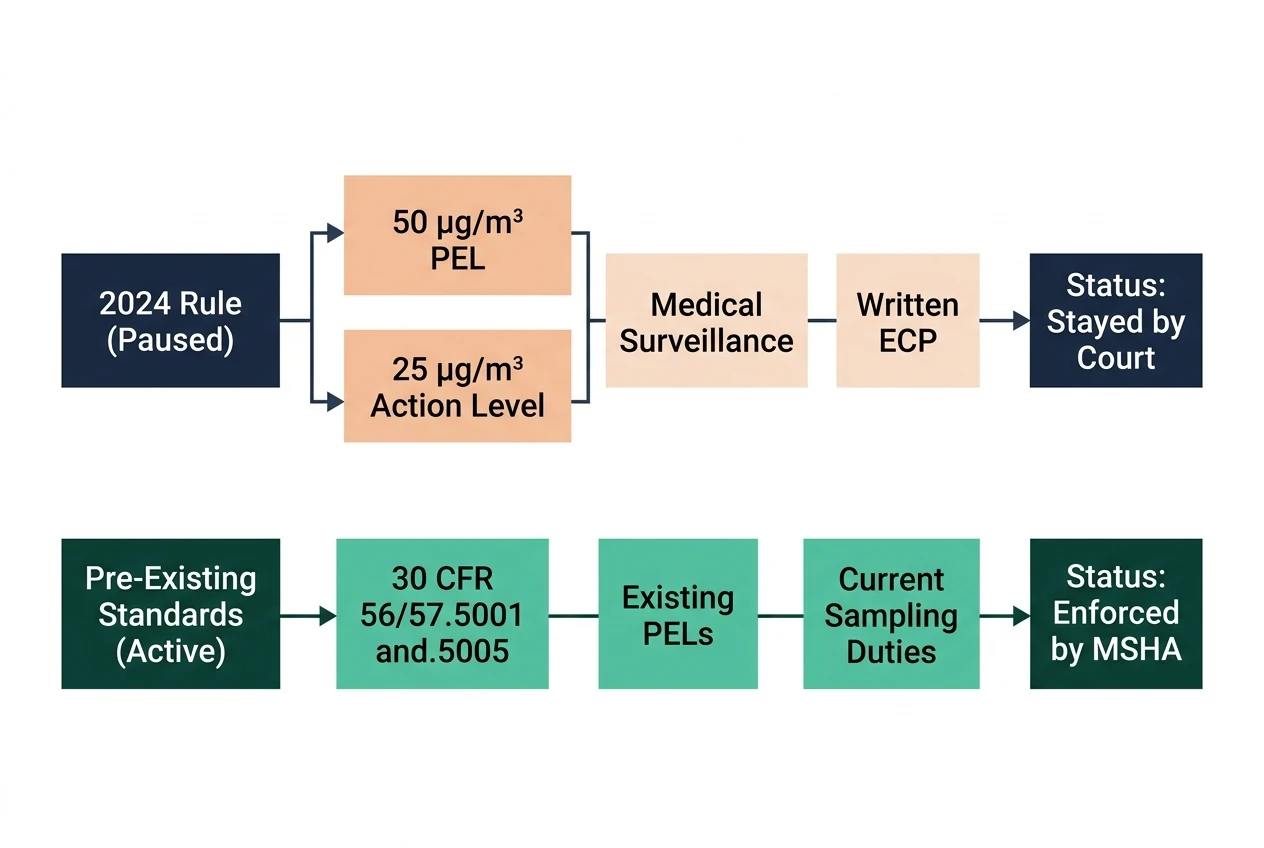
The contested 2024 rule was designed to set a uniform permissible exposure limit (PEL) of 50 µg/m³ as an 8-hour time-weighted average (TWA) and a new action level of 25 µg/m³. According to MSHA stakeholder meeting slides, the final rule establishes a full-shift respirable crystalline silica action level of 25 µg/m³ and a PEL of 50 µg/m³.
Exposure Triggers and Compliance Duties
When a sample hits the 25 µg/m³ action level, the rule requires you to begin monitoring exposures and tracking medical surveillance. Exceeding the 50 µg/m³ PEL triggers additional duties: written exposure control plans, engineering controls, and respiratory protection until you bring exposures below the limit.
These are tiered requirements. The action level is the tripwire; the PEL is the hard ceiling.
If you have never worked under a two-threshold system, you will need to rethink how you prioritize sampling and corrective action.
Original Compliance Deadlines
The Federal Register final rule originally set coal mine compliance at 14 April 2025 and metal/nonmetal mine compliance at 8 April 2026. Neither deadline is currently in effect, as explained in the next section.
Current Status: What Is Paused and What Is Still Enforced
This is the question most mining operations need answered first. The short version: the 2024 rule's new duties are paused. The older silica standards remain fully enforceable.
The Judicial Stay and MSHA's Indefinite Delay
On April 11, 2025, the U.S. Court of Appeals for the Eighth Circuit issued an indefinite judicial stay of the 2024 rule's deadlines pending judicial review. MSHA followed on April 6, 2026, publishing a final rule that indefinitely delays the rule's conforming amendments.
In practical terms, you do not currently have to meet the new 2024 rule requirements while litigation proceeds.
Pre-Existing Standards Remain Active
Even with the 2024 rule's deadlines paused, you still have enforceable legal duties to control silica exposure under longstanding MSHA requirements. For MNM mines, MSHA continues enforcing the prior standards in 30 CFR 56.5001, 56.5005, 57.5001, and 57.5005. Coal mines remain subject to their existing dust standards as well.
Are you tracking which of your current duties fall under the old standards versus the paused rule? If that distinction is unclear at your site, you have a gap in your records that inspectors will find. Resources on MSHA silica compliance requirements can help you clarify which framework governs your operation today.
How Did the MSHA Silica Rule Update Change the Compliance Timeline?
Many compliance guides written in 2024 and early 2025 treated the April 2025 and April 2026 deadlines as fixed. The MSHA silica rule update, through both the judicial stay and MSHA's own delay action, has removed those deadlines from the active calendar.
Think of it like a construction project where the city pulled the building permit mid-pour. The foundation work you already completed still matters, but the inspection schedule is suspended until the permit dispute resolves. You still have a building to maintain in the meantime.
What Reactivation Could Look Like
If the Eighth Circuit ultimately upholds the rule in full or in part, MSHA would likely set new deadlines. Those deadlines could be shorter than the original timeline, because MSHA may argue that you have already had years to prepare.
If you treated the delay as permission to stop preparing, you will face a compressed sprint. If you kept building your program, you will transition with far less disruption.
Which Sampling, Engineering Controls, and Respiratory Steps Should Mines Take Now?
The delay creates a window. How you use it determines whether your operation is scrambling or ready when deadlines return.
Maintain and Improve Exposure Controls Under Existing Standards
Wet suppression, ventilation improvements, enclosed cabs with appropriate filtration, and dust collection at transfer points remain core elements of a defensible program. You are still required to run these controls under the pre-existing MSHA silica dust standard, which remains fully enforceable during the pause.
Where you are most likely to struggle is in day-to-day follow-through: keeping controls running consistently, documenting what you do, and closing out corrective actions promptly after elevated dust events.
Use this period to tighten how you verify controls and standardize how you close out corrective actions across shifts.
Keep Sampling and Documentation Inspection-Ready
Even though the 2024 rule's new PEL and action level are paused, your sampling records remain the primary evidence that your program is active and site-specific. Inspectors will expect records that reflect what actually happens at your site, with dates, locations, and task-level detail.
Traditional sampling runs can cost $20K to $50K per campaign. If you are running multiple campaigns per year without clear data on which tasks drive the highest exposures, you may be spending heavily while still missing the sources that matter most. Teams focused on reducing silica exposure under MSHA requirements are shifting toward data that identifies root causes on the first pass.
Where Real-Time Monitoring Can Strengthen How You Manage Exposure
Traditional sampling creates time lags between when workers are exposed and when you can act, especially when lab turnaround stretches into weeks. A site manager at a surface coal operation we worked with described the problem plainly: by the time lab results arrived showing a spike at the crusher, the crew had already rotated, the haul pattern had changed, and the data pointed to a situation that no longer existed. The corrective action became a guess.
Real-time monitoring closes that gap. Continuous sensors pinpoint which tasks and locations generate the highest concentrations so you can target engineering controls where they will have the greatest impact. Applied Particle Technology works with mining operations to do exactly this. Teams using APT's platform have achieved 75% fewer sampling campaigns by identifying root causes faster through continuous monitoring rather than periodic grab samples.
If you are evaluating how respirable dust monitoring helps meet OSHA and MSHA standards, continuous data is what separates reactive compliance from proactive risk reduction.
How Does the MSHA Silica Standard Differ From the Older Standards Still in Force?
The distinction between the MSHA respirable crystalline silica standard issued in 2024 and the pre-existing rules matters for every compliance decision you make during the delay.
- Element: PEL structure | Pre-Existing Standards (Active): Formula-based, varies by quartz percentage | 2024 Rule (Paused): Uniform 50 µg/m³ (8-hr TWA)
- Element: Action level | Pre-Existing Standards (Active): None defined | 2024 Rule (Paused): 25 µg/m³ (8-hr TWA)
- Element: Medical surveillance | Pre-Existing Standards (Active): Limited requirements | 2024 Rule (Paused): Triggered at action level
- Element: Written exposure control plan | Pre-Existing Standards (Active): Not required | 2024 Rule (Paused): Required when PEL exceeded
- Element: Coal vs. MNM alignment | Pre-Existing Standards (Active): Separate frameworks | 2024 Rule (Paused): Unified standard
The biggest operational difference is the action level. Under the old MSHA silica dust standard, there is no formal 25 µg/m³ trigger. The 2024 rule introduced that threshold as the point where you must begin monitoring and providing medical surveillance.
If you are preparing to comply in case the rule is reinstated, understanding permissible exposure limits for silica and dust across both MSHA and OSHA frameworks is worth your time now rather than during a compressed deadline.
What Does the MSHA Silica Rule Lawsuit Mean for 2026 Planning?
The MSHA silica rule lawsuit, filed by industry groups challenging the rule's feasibility and cost burden, is the reason the deadlines are currently stayed. The Eighth Circuit's decision will determine whether the rule takes effect as written, is modified, or is vacated.
Three Possible Outcomes and Their Impact
The court could uphold the rule, which would likely mean new deadlines set by MSHA. It could vacate the rule entirely, returning enforcement to the pre-existing standards indefinitely. Or it could remand specific provisions back to MSHA for revision, creating a hybrid outcome.
Each scenario produces a different burden on your operation. But in all three, the underlying exposure hazard is identical.
Exposure Data Tells the Same Story Regardless of the Ruling
In 2026 congressional testimony, a U.S. House of Representatives hearing record showed that 43.5% of evaluated shops had at least one respirable crystalline silica sample above OSHA's action level, and 9.2% of samples exceeded the OSHA PEL.
Those numbers come from general industry. Mining exceedance rates, as the 20-year MSHA data shows, follow a similar pattern. The MSHA silica rule lawsuit may change when you must comply. It will not change the lung disease outcomes of uncontrolled exposure.
If you are building a silica exposure control plan, the medical evidence points the same direction under any regulatory outcome.
Why the Safest 2026 Plan Is to Control Exposure Before Deadlines Move Again
"Paused" does not mean "risk-free." MSHA inspectors continue citing mines under the existing MSHA silica standard. Silica-related disease does not wait for courts. And MSHA citations can cost you up to $8K each, plus legal fees, under the standards already in force.
What would your operation look like if the Eighth Circuit issued a ruling next quarter and MSHA set a six-month compliance window? If the answer involves scrambling for baseline data, writing exposure control plans from scratch, or funding emergency engineering controls, the delay is costing you preparation time you cannot recover.
Turning Compliance Costs Into Measurable Savings
You are probably spending heavily to manage dust and silica without the right data. APT helps you turn those costs into measurable savings: $500k on average in avoided capital projects and $1M to $2M per year in possible savings with smarter suppression alone.
The latest MSHA silica rule developments reinforce why preparing now is cheaper than reacting later. If you invest in continuous monitoring during the delay, you are building the exact data infrastructure the 2024 rule would require if reinstated.
Frequently Asked Questions
How should EHS and operations teams coordinate during the MSHA silica rule delay?
Set a shared weekly rhythm that ties production changes to exposure risk, for example, shift startup huddles plus a short cross functional review of dust events and corrective actions. Align on a single owner for each control, a deadline for closeout, and a documented escalation path when fixes affect uptime.
What training topics should you prioritize for supervisors and crews right now?
Focus on task specific dust generation points, correct use and limits of controls, and how to recognize when a control is underperforming. Add simple decision rules for when to stop work, adjust the process, or call maintenance, then document your refresher training by crew and role.
How can you choose where to monitor first if you cannot sample everything?
Start with a risk based map of your highest dust tasks, most frequent tasks, and areas with the most worker time, then prioritize those intersections. Use a short pilot to validate your assumptions and expand only after you can show the monitoring data is driving specific corrective actions.
What should you have ready in case MSHA reinstates deadlines with little notice?
Prepare a draft plan with milestones, responsible owners, budget ranges, and vendor lead times for controls and monitoring. Having procurement, maintenance capacity, and baseline operating conditions documented helps you move fast without making expensive last minute choices.
How do you verify that respiratory protection is being used effectively?
Check your fit testing cadence, cartridge change schedules, and user seal checks, then audit real world wear time during high dust tasks. Track exceptions and re-train based on observed issues, because inconsistent use often creates the biggest gap between policy and protection.
What documentation practices make your silica program easier to defend during an inspection?
Keep a clean chain from hazard identification to control selection to verification, with dates, photos, work orders, and sign-offs that show you put the fix in place and maintained it. Inspectors tend to trust records that are site specific, time stamped, and tied to measurable checks rather than narrative statements alone.
How should you manage contractors and visitors in your silica exposure control program?
Require contractors to follow your site dust control rules, PPE requirements, and reporting procedures, then brief them on the specific high risk areas and tasks before access. Include contractor activities in your control checks and incident reviews so temporary work does not create untracked exposure spikes.
Rule Uncertainty Is Temporary. Exposure Risk Is Not.
The MSHA silica rule's legal future remains unresolved, but the operational calculus is straightforward. Pre-existing silica standards are enforced today. Inspectors are active. Respirable crystalline silica causes irreversible disease on a timeline that has nothing to do with court dockets.
Every site that uses the delay to close gaps in records, verify that controls stay running, and identify which tasks drive the highest exposures will be in a stronger position under any ruling.
Start with the controls and data quality you can improve this quarter. Whether the MSHA silica rule is ultimately upheld, modified, or vacated, that investment protects your workers and your operation under every scenario. That is the only 2026 plan that works regardless of what the Eighth Circuit decides.
See Your Dust Data Before the Next Deadline Arrives
Applied Particle Technology gives EHS and operations teams the real-time data they need to manage silica exposure with confidence and cut sampling costs, all while building a compliance program that holds up under inspection. Book a personalized demo to see how APT's platform works at your site.
Take a tour of APT's dust management platform

Vulcan Materials Company is the nation’s largest producer of construction aggregates.

Project partner
Brent Leclerc | Environmental Manager
Problems solved
Unjustified community dust complaints & lawsuits
Difficulty complying with opacity regulations and risk of NOVs
Solution
Real-time dust monitoring
Dust maps proving no community impact, preventing fines & lawsuits
Real-time opacity monitoring, high degree of compliance




Better decisions start with real-time insight
APT helps industrial teams move faster, act smarter, and stay compliant—because when you can see the problem clearly, you can solve it confidently.
