Back to blog

Dust Suppression in Mining: Methods, Systems, and Best Practices

Learn dust suppression strategies for mining sites. Compare methods, match controls to haul roads and crushers, and support safety and compliance decisions.

Every open-pit blast, every haul truck lap, every crusher cycle sends particulate matter into the air that your workers breathe, your neighbors complain about, and your regulators measure. Dust suppression is the set of engineered controls that keeps those particles from becoming a health crisis, an environmental violation, or a production bottleneck. Yet too many operations still treat it as an afterthought, spraying water from a truck and hoping for the best.

This guide breaks down the methods, systems, and decision-making frameworks that separate reactive dust management from a proactive, cost-effective program. You'll learn which suppression approach fits each source on your site, how to measure whether it's actually working, and the mistakes that quietly erode compliance and safety.

What Dust Suppression Means in a Mining Context

Dust suppression refers to any method that prevents airborne particles from becoming or remaining suspended at the source. It differs from dust collection, which captures particles after they've become airborne through filters or ventilation. In mining, the distinction matters because suppression is almost always cheaper, simpler to maintain, and more effective at protecting workers in open environments where ductwork isn't practical.

The particles you're fighting vary widely. Haul roads generate coarse dust visible from a kilometer away, while crushers release fine respirable silica that you can't see but that destroys lung tissue over years of exposure. MSHA's permissible exposure limit for respirable crystalline silica sits at 50 micrograms per cubic meter, a threshold many sites struggle to maintain without a deliberate, multi-method approach.

Understanding this regulatory backdrop is non-negotiable. OSHA, MSHA, the EPA, and state-level agencies each impose overlapping requirements. Fines are one risk. The bigger one is long-term liability from silicosis claims that surface decades after exposure. A strong mining dust control program treats suppression not as a line item but as an operational discipline woven into every process area.

Why Dust Suppression Matters for Health, Safety, and Productivity

The health case is clear-cut. Prolonged exposure to respirable dust causes silicosis, chronic obstructive pulmonary disease, and lung cancer. These aren't abstract risks. Underground and surface miners in the United States still develop occupational lung disease at rates that alarm public health researchers. Beyond respiratory illness, airborne dust reduces visibility on haul roads, contributing directly to vehicle collisions that rank among the top causes of mining fatalities.

The financial case is equally compelling. According to the ERM 2026 Annual Trends Report, 79% of respondents reported significant operational efficiency improvements from EHS investments. That statistic reflects a broader trend: operations that invest in environmental controls don't just avoid fines, they run better. Dust clogs air filters on heavy equipment, accelerates wear on engine components, and forces more frequent maintenance shutdowns.

The ESG and Community Dimension

Mining companies face growing pressure from investors, communities, and permitting agencies to demonstrate environmental stewardship. A CSE sustainability analysis found a very strong positive correlation between ESG-sustainability practices and financial performance among the most profitable companies across 21 sectors. Dust management sits squarely within the "E" of ESG, and visible dust plumes drifting off-site are among the fastest ways to trigger community opposition and permitting delays.

In short, effective suppression protects lungs, protects equipment, protects your social license to operate, and frequently pays for itself through reduced downtime and water costs.

Types of Dust Suppression Methods

No single method handles every dust source on a mine site. The most effective programs layer multiple techniques based on particle size, generation mechanism, and environmental conditions. Here's what each approach does well and where it falls short.

Water Sprays and Misting

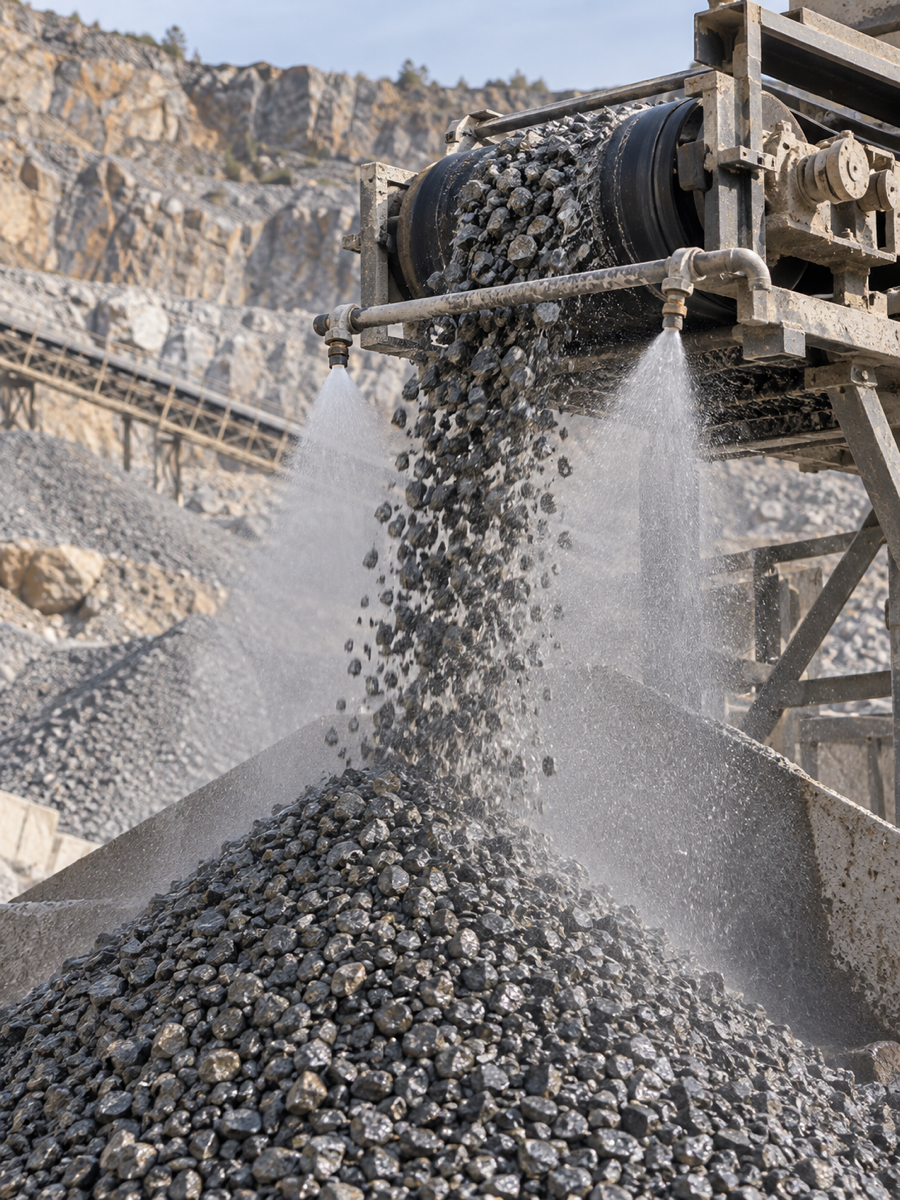
Water remains the most widely used suppressant in mining, and for good reason: it's available, familiar, and effective when applied correctly. Low-pressure sprays work by wetting material surfaces to prevent particle release. High-pressure misting systems atomize water into fine droplets that match the size of respirable dust particles, which makes them far more effective at capturing the smallest and most dangerous fraction.

The National Safety Council highlighted site trials where high-pressure mist systems achieved an 80% reduction in respirable dust at crusher discharge points while trimming water consumption by about 35%. Droplet size matters enormously here. A 10-micron water droplet captures 5-micron dust particles far more efficiently than a 500-micron droplet from a garden hose. Nozzle selection, operating pressure, and spray pattern all determine whether you're suppressing dust or just making mud.

The main drawback is water consumption. In arid regions, water availability limits how aggressively you can spray. Over-application also creates slippery surfaces, material handling problems, and runoff concerns.

Chemical Suppressants

Chemical additives extend the effectiveness of water-based programs and, in some cases, replace water entirely. Surfactant blends reduce water's surface tension so that each droplet wets a larger area of material. Polymer binders form crusts on stockpiles and unpaved surfaces that resist wind erosion for days or weeks. Calcium chloride and magnesium chloride attract moisture from the atmosphere, keeping road surfaces damp without constant re-application.

According to Future Market Insights' 2026 market analysis, global surface-mine operators who adopted surfactant-enhanced programs reduced water-truck trips by roughly 30-40% while meeting tightened exposure limits. That's a meaningful operational savings, not just an environmental win.

A Fact.MR study documented an even more dramatic result in water-scarce environments: polymer-based dry suppressants stretched re-application intervals from daily watering to 10-14 day maintenance cycles, cutting water use by up to 90% and lowering dust counts by 75%. I'd recommend polymer binders as the first option to evaluate for any operation where water scarcity is a real constraint. The upfront chemical cost pays back quickly in reduced water hauling and labor.

One honest caveat: not all chemical suppressants are environmentally benign. Some older formulations contain compounds that leach into soil and water. Always verify biodegradability ratings and regulatory approval before deploying a new product, especially near waterways.

Fog Cannons

Fog cannons (also called mist cannons) project a fine mist cloud over a targeted area using a turbine-driven fan. They're effective for stockpiles, transfer points, and open areas where traditional spray bars can't reach. A single unit can cover a radius of 50 to 150 meters depending on the model.

They excel at suppressing wind-driven dust from stockpiles because the mist cloud travels with the wind direction. The trade-off is that they're power-hungry and less effective in high crosswinds that scatter the mist before it contacts dust particles.

Windbreaks and Barriers

Physical barriers reduce wind velocity at ground level, which directly reduces the force available to lift particles off exposed surfaces. Solid or porous fence systems installed upwind of stockpiles and along haul road edges can cut wind speed by 50-80% within a zone extending roughly 10 times the barrier height downwind.

Windbreaks work best as a complement to other methods, not a standalone solution. They don't address mechanically generated dust from vehicle traffic or material handling. But they're passive, require minimal maintenance, and provide consistent performance regardless of water availability.

Enclosures

Fully or partially enclosing dust-generating equipment is the most effective suppression strategy when the geometry allows it. Enclosed crusher buildings, covered conveyors, and sealed transfer chutes contain dust at the source and allow ventilation systems to capture what escapes. The cost is high, and retrofitting existing equipment is often impractical. For new plant designs, though, engineering enclosures from the start dramatically simplifies compliance.

Choosing the Right Dust Suppression Method by Source

Matching methods to sources is where dust management programs succeed or fail. A method that works brilliantly at a crusher may waste money on a haul road. Here's a practical breakdown.

Haul Roads

Haul roads are typically the single largest dust source on a mine site, accounting for 40-80% of total particulate emissions. Water trucks remain the default, but their effectiveness drops within minutes on hot, dry days. Chemical stabilizers and surfactant-treated water extend suppression duration significantly. For permanent haul roads, consider polymer emulsion treatments that create a semi-permanent surface crust. Speed management also helps: reducing truck speed from 60 km/h to 40 km/h can cut dust generation by more than half.

Crushers and Screens

These generate intense, localized dust plumes at feed points, discharge points, and screen decks. High-pressure misting systems at transfer points paired with partial enclosures deliver the best results. Foam suppression is another option worth considering at primary crushers, as foam clings to material surfaces longer than water mist. Integrating suppression with a real-time dust monitoring system allows you to ramp spray rates up and down based on actual dust levels rather than running at maximum output constantly.

Stockpiles

Wind erosion from stockpiles is highly variable, spiking during gusts and calm during still conditions. Fog cannons positioned upwind handle active pile faces. Polymer crusting agents work well on inactive areas that won't be disturbed for days. Windbreaks reduce the baseline erosion rate. The worst approach? Ignoring stockpile dust because it's "not as bad" as road dust. Regulators measure it, communities see it, and it adds up.

Loading and Dumping

Every time a shovel dumps material into a truck or a truck dumps into a hopper, the free-fall releases a burst of dust. Reducing drop height is the simplest fix. Water sprays at dump pockets and load-out points address the remainder. Automated spray triggers activated by proximity sensors avoid the waste of continuous spraying when no loading activity occurs.

Measuring Dust Suppression Effectiveness

You can't manage what you don't measure, and too many operations rely on visual observation alone. If you can see dust, the problem is already severe. The most dangerous particles, those below 10 microns, are invisible to the naked eye.

Real-time particulate monitors deployed at key locations provide continuous data on PM2.5, PM10, and total suspended particulate levels. This data does three things: it validates whether your suppression methods actually work, it triggers automated responses when levels spike, and it creates a defensible compliance record. Organizations that prioritize reducing dust exposure through real-time data consistently outperform those relying on periodic sampling alone.

Key Metrics to Track

Opacity readings give a rough visual proxy but lack precision. Gravimetric sampling provides accurate mass concentrations but only after lab analysis, meaning days of delay. Continuous optical monitors fill the gap with minute-by-minute readings that feed directly into control systems.

Track suppression efficiency as a percentage reduction from baseline. If your haul road baseline is 800 micrograms per cubic meter and your treated road reads 200, that's 75% efficiency. Compare methods head-to-head under similar conditions. Research like the NIOSH deployment of dust sensors in silica monitoring studies demonstrates how granular sensor data strengthens both compliance documentation and method optimization.

Common Mistakes That Undermine Dust Control Programs

Even well-intentioned programs stumble on predictable errors. Recognizing them saves money and exposure risk.

Relying on a single method. Water trucks alone won't maintain compliance across an entire mine site. Layering chemical treatment, physical barriers, and engineering controls creates resilience when any one method underperforms.

Ignoring maintenance. Clogged nozzles, leaking pumps, and corroded pipes degrade spray system performance gradually. By the time someone notices visible dust returning, the system may have been operating at 50% capacity for weeks. Preventive maintenance schedules for nozzle inspection, pump pressure checks, and filter replacement are non-negotiable.

Over-watering. More water doesn't always mean less dust. Excessive application wastes a scarce resource, creates safety hazards on road surfaces, and generates contaminated runoff. Precise, sensor-triggered application outperforms brute-force spraying every time.

Treating suppression as someone else's job. When dust control responsibility sits exclusively with environmental staff, operational decisions that generate dust happen without input from the people tasked with controlling it. Effective programs embed dust awareness into shift briefings, truck operator training, and maintenance planning.

Failing to adapt to conditions. A program designed for summer doesn't work in winter. Frozen spray lines, dust from dry frozen surfaces, and wind pattern shifts all require seasonal adjustments. Sites in arid regions face the inverse problem when rare rain events temporarily reduce dust, tempting operators to pull back resources right before the next dry spell.

  • Dust Source: Haul Roads | Best Primary Method: Chemical-treated water | Effective Complement: Speed management | Common Pitfall: Water-only approach in arid climates
  • Dust Source: Crushers/Screens | Best Primary Method: High-pressure misting | Effective Complement: Partial enclosures | Common Pitfall: Low-pressure sprays that create mud, not suppression
  • Dust Source: Stockpiles | Best Primary Method: Fog cannons (active faces) | Effective Complement: Polymer crusting and windbreaks | Common Pitfall: Ignoring inactive pile surfaces
  • Dust Source: Loading/Dumping | Best Primary Method: Automated spray triggers | Effective Complement: Reduced drop height | Common Pitfall: Continuous spraying without activity sensors

Frequently Asked Questions

How do I choose between suppression and collection for a specific dust source?

Start by assessing whether the source is open and dispersed or enclosed and ductable. Suppression is typically better for open areas like roads and stockpiles, while collection makes sense where you can contain airflow (for example, inside a building or at a sealed transfer point). A short site survey that maps airflow paths and access to power, water, and maintenance support usually clarifies the best fit.

What should be included in a dust suppression system commissioning checklist?

Commissioning should verify mechanical installation (nozzle placement, pipe routing, strainers, valves), controls logic (interlocks, alarms, automated start-stop), and performance under real operating conditions. Document setpoints, calibration certificates for instruments, and baseline readings so future troubleshooting is faster. Capture photos and as-built drawings, they become invaluable for maintenance and audits.

How can we prevent dust suppression systems from causing corrosion, scaling, or premature wear?

Water chemistry management is a major lever, including filtration, hardness control, and selecting wetted materials compatible with additives and site water. Use strainers sized for nozzle orifices, implement routine flush cycles, and standardize spare parts to reduce downtime. For chemical programs, confirm compatibility with pumps, seals, and hose materials before full deployment.

What training should equipment operators receive to support dust control without slowing production?

Focus on practical behaviors, such as recognizing early signs of underperforming suppression (dry spots, unusual plume behavior), reporting issues with clear location and time, and following safe operating practices around wet surfaces and visibility changes. Keep it role-specific for haul truck drivers, loader operators, and plant crews, and tie training to pre-start checks. Refresher training after seasonal changes or process modifications helps prevent drift.

How do I build a preventive maintenance plan for dust control equipment that is realistic for busy sites?

Create tiers of tasks, daily quick checks by operators, weekly inspections by maintenance, and periodic deeper servicing aligned with shutdown windows. Use simple leading indicators, such as pressure drop across filters, pump amperage, and nozzle flow verification, to catch degradation early. Assign clear ownership and stock critical spares so small failures do not become extended compliance risks.

What are the most common procurement mistakes when buying dust suppression chemicals or equipment?

A frequent error is choosing based on unit price rather than total cost of ownership, including application rate, labor, downtime, and maintenance complexity. Another is skipping site-specific trials, which can reveal performance differences due to water quality, material type, and climate. Require vendor documentation on safety data, disposal guidance, and compatibility, and lock in service support expectations before purchase.

How should dust control be handled during atypical events like plant upsets, blasting, or temporary construction?

Plan for surge conditions with predefined response playbooks, including temporary mobile units, adjusted operating sequences, and clear trigger points for escalation. Coordinate with production and contractors so dust controls are not removed, bypassed, or left unpowered during short-term work. After the event, conduct a quick review to capture lessons learned and update procedures for next time.

Building a Dust Management Program That Holds Up

Effective dust suppression isn't about buying the most expensive equipment or applying the most water. It's about matching methods to sources, measuring outcomes with real data, and adjusting continuously as conditions change. The operations that get this right treat dust control as an engineering discipline, not a box to check on an inspection form.

Start by mapping every dust source on your site and assigning a primary and secondary suppression method to each. Build measurement into the plan from day one so you have data to prove what works. Train operators to recognize when systems underperform, and give them authority to escalate issues before they become violations.

Applied Particle Technology's platform integrates real-time dust sensors with intelligent software to give your environmental and operations teams the visibility they need to act on dust conditions as they develop, not days later when lab results arrive. If you're ready to move from reactive spraying to data-driven dust management, explore how APT's monitoring solutions can strengthen your program and simplify compliance.

Take a tour of APT's dust management platform

Vulcan Materials Company is the nation’s largest producer of construction aggregates.

Project partner

Brent Leclerc | Environmental Manager

Problems solved

Unjustified community dust complaints & lawsuits

Difficulty complying with opacity regulations and risk of NOVs

Solution

Real-time dust monitoring

Dust maps proving no community impact, preventing fines & lawsuits

Real-time opacity monitoring, high degree of compliance

Case study overview

Share this article

Better decisions start with real-time insight

APT helps industrial teams move faster, act smarter, and stay compliant—because when you can see the problem clearly, you can solve it confidently.