Connect every sample to the decisions that follow with LEAP IH

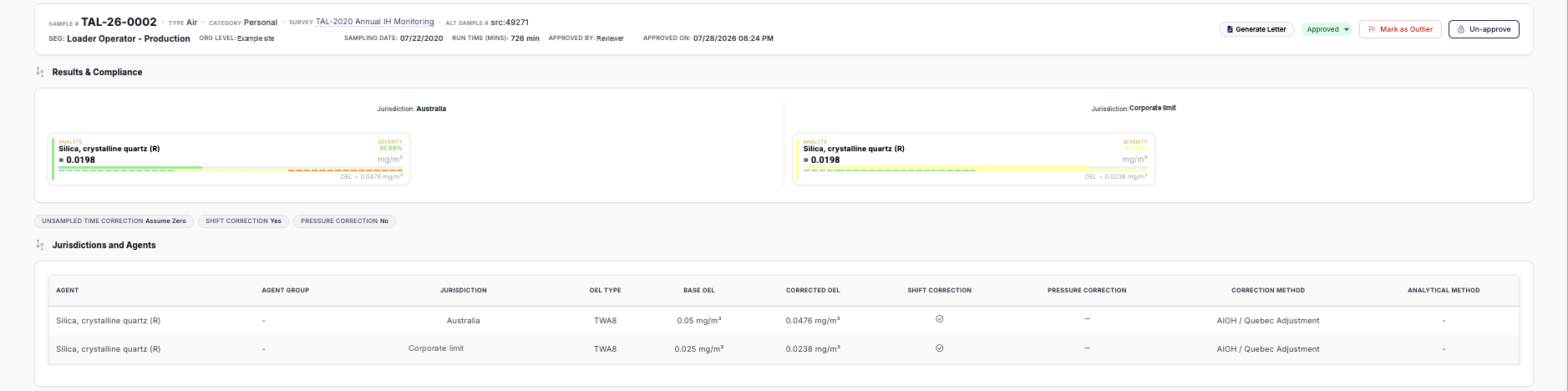
LEAP IH keeps sampling records, lab results, SEGs, OELs, risk assessments, controls, and reports connected across sites. Your team uses the same underlying data through each step.

Schedule a callBring one IH workflow. We'll show how LEAP fits.

Give your EHS team one connected IH program across every site.
app.leapih.com/risk-assessmentsLiveSIMILAR EXPOSURE GROUPSUnderground development crewUnderground 2 · n=16Crusher operatorsPlant 1 · n=12Haul truck driversSite A · n=22Bagging linePlant 1 · n=9Maintenance shopSite A · n=4Concentrator wet millPlant 1 · n=11FILTERSAgent: Respirable silicaBasis: 50 µg/m³, 8 hour TWAWindow: 12 monthsSampling: personal, 8 hourSAVED VIEWSQ3 silica surveillanceUnderground assessmentsRecently updatedCrusher operators, Plant 1SEG-014AgentRespirable crystalline silicaBasisRegulatory limit 50 µg/m³, 8 hour TWAWorkers in SEG12Samples, 12 months14Assessment date2026-08-22STATISTICAL SUMMARYGeometric mean42µg/m³GSD1.995% UCL118µg/m³OEL50µg/m³EN 689 DECISIONNon-compliant95% UCL of 118 µg/m³ exceeds theapplicable OEL of 50 µg/m³.Controls review required.Open taskReviewer: JWNext scheduled review: 2027-02-15Exposure trend, 12 monthsAug 2025 to Jul 2026200150100500OEL 50 µg/m³AugSepOctNovDecJanFebMarAprMayJunJulExposure, µg/m³TREND SUMMARY12 month change-60%Samples in window14Last sample2026-07-28Ventilation upgrade commissioned Jun 2026.Values remain above OEL in the latest window.

Collecting a sample is only the start

Lab results, SEG structures, assessments, and reports often live in separate systems. Hygienists re-enter data and rebuild analyses, while older records become harder to compare across sites.

LEAP keeps the underlying record connected through the assessment, control work, reporting, and employee communication.

LEAP follows your IH workflow

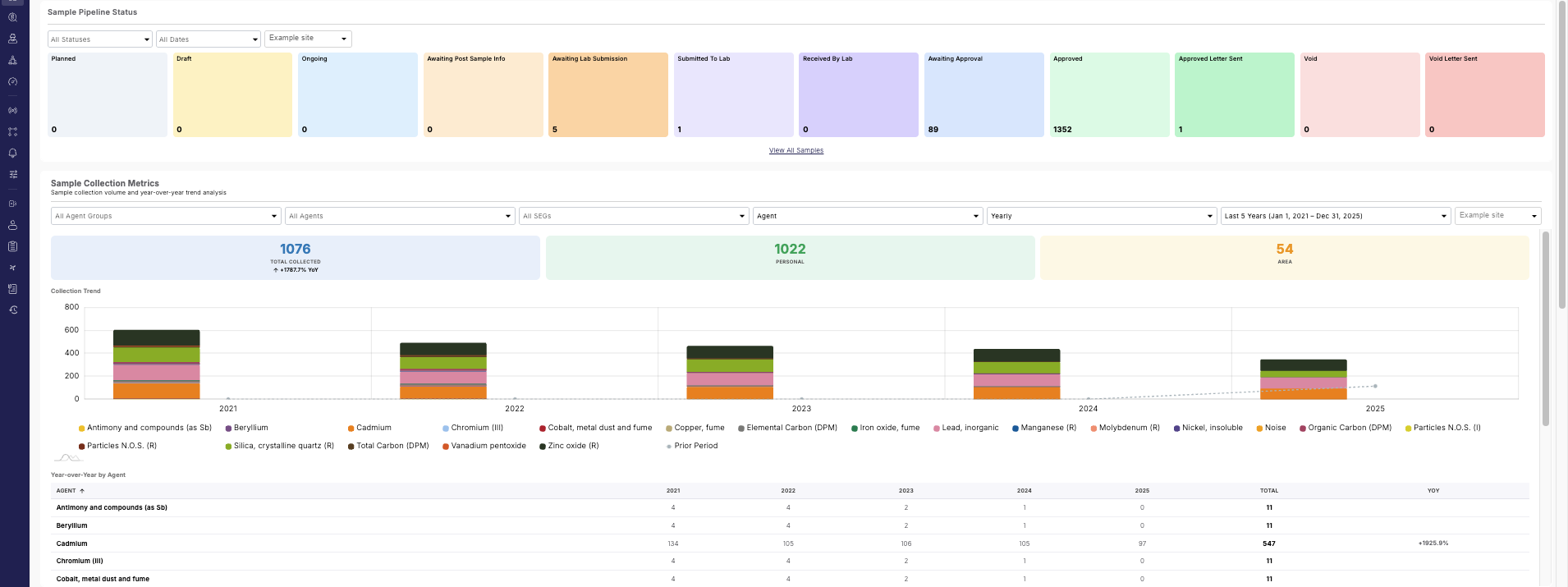
LEAP IH is purpose-built software for managing exposure data and the decisions that follow. Site teams use it for daily sample work. Corporate EHS uses it to keep the program consistent across locations and to evaluate exposure risk globally.

The system starts with program structure and sample collection. Once the data is in, the same record supports exposure statistics, risk assessment, control tracking, reports, and employee communication.

One record. Every data stream stitched to the sample.Field capture, custody, lab result, worker assignment, and history all write to the same record ID.LEAP recordSample IDRS-2026-08-14-0421One immutable record per sampleFIELD SAMPLECollected 08/1406:22, Site AMobile capture, offline safeLAB RESULT42 µg/m³Received 08/18Lab portal ingest, auto matchedWORKER ASSIGNMENTEMP-0421Crusher operatorsPlant 1, day shiftHISTORICAL EXPOSURES14 samples12 month window, per SEGCHAIN OF CUSTODY3 signed transfersField, shipper, labTimestamped and hashedEvery arrow writes into the same record ID. Nothing lives outside it.

Put current and historical samples in the same structure

LEAP handles sampling plans, sample records, equipment, calibration, and chain-of-custody documentation. The mobile workflow supports sample collection in the field, including offline use in areas with limited connectivity.

Lab results can flow into LEAP from your labs, and HRIS data can support employee and organizational records. During implementation, APT maps spreadsheets and historical databases into the same structure.

A sample entered in the field can carry through to the assessment, control record, report, and exposure letter. All data management is auditable.
From field to record: four steps, one system1. FIELD CAPTURE9:41Log sampleWORKER IDEMP-0421SEGCrusher operators, Plant 1SAMPLE TYPERespirable, personalPUMP IDP-14START TIME06:22, 2026-08-14Start captureOffline. Syncs on connection.2. CHAIN OF CUSTODYSAMPLE IDRS-2026-08-14-0421Timestamp hash a41c9e...bd07CUSTODY LOG08/14 14:05SMSite A field to shipper dock08/16 09:12JRShipper to lab receiving08/16 09:47KTLab receiving to analyst3 signed transfers on this sample.All handoffs timestamped and hashed.Custody events replay on the record page.3. LAB INGESTLAB PORTALingestMATCHED FIELDSSample IDRS-2026-08-14-0421MethodRespirable silica, XRDResult42 µg/m³STATUSReceived 2026-08-18Auto-matched to field sampleChain of custody validatedNo rekeying. No orphan results.4. RECORD COMPLETERECORD IDRS-2026-08-14-0421Immutable, versioned, exportableRecord completeField capture08/14Custody log3 transfersLab result42 µg/m³WorkerEMP-0421SEGCrusher operatorsOne record. Five streams. No copies.Each step writes into the same record ID. Provenance stays with the sample.

Set program-wide standards and keep site-level differences

Corporate EHS can set shared SEG structures and agent libraries at the appropriate level. It can also set exposure limits by jurisdiction. Sites keep the job, task, shift, and jurisdiction details needed for local work.

LEAP supports jurisdiction-specific OELs and shift adjustments. Permissions can separate corporate visibility, site management, sample collection, and access to real-time data.

Sites work from the same program structure while keeping the operation and jurisdiction details they need.
app.leapih.com/seg-librarySITEAll sitesPlant 1Underground 2Site AAGENTRespirable silicaTotal dustDiesel PMJURISDICTIONUS-OSHAUS-MSHAEU-EN689AU-SafeworkSEG library8 similar exposure groups matching your filtersExport reportSEG NAMESITEWORKERSSAMPLESOEL BASIS95% UCL (µg/m³)STATUSCrusher operatorsPlant 1121450 µg/m³, 8 hr TWA118Non-compliantUnderground development crewUnderground 2162250 µg/m³, 8 hr TWA38CompliantHaul truck driversSite A221850 µg/m³, 8 hr TWA41CompliantBagging linePlant 191150 µg/m³, 8 hr TWA62Non-compliantMaintenance shopSite A4350 µg/m³, 8 hr TWAn/aInsufficient dataConcentrator wet millPlant 1111450 µg/m³, 8 hr TWA29CompliantDrill operatorsSite A81050 µg/m³, 8 hr TWA74Non-compliantLoad haul dump operatorsUnderground 2141750 µg/m³, 8 hr TWA44CompliantWarehouse loadersPlant 16850 µg/m³, 8 hr TWA32CompliantShowing 8 of 8 SEGsSorted by SEG nameSTATUS LEGENDCompliant95% UCL below OELNon-compliant95% UCL above OELInsufficient dataFewer than 6 samples in windowSELECTION3 SEGs selected. Open the risk assessment, add a sample, or export a batch report.Batch actions apply the current filter set.

Use the data already in LEAP for the assessment

LEAP supports qualitative and quantitative health risk assessments, EN 689 decision logic, AIHA methods, Bayesian analysis, 95th-percentile decision statistics, and configurable risk thresholds.

The hygienist chooses the decision basis and records the conclusion in LEAP. Controls can carry an owner, status, review date, and evidence from before and after the change.

The statistics and professional judgment stay attached to the risk decision.
app.leapih.com/assessments/A-2026-118EN 689 ASSESSMENT · A-2026-118Crusher operators, Plant 1Respirable crystalline silica · 8 hour TWA · personal samplingReviewerJWAssessment date2026-08-22Statistical outputLognormal distributionSamples (n)14Geometric mean42µg/m³GSD1.995% UCL118µg/m³OEL50µg/m³UCL / OEL2.36EN 689 DECISIONNon-compliant95% UCL exceeds the applicable OEL.HYGIENIST DECISIONNon-compliant. Action required.Ventilation upgrade scoped for Q4.Interim: respirator program review andwet suppression audit on the primary crusher.JWCertified industrial hygienist · 2026-08-22Exposure distribution14 samples · 12 month window432100-2525-5050-7575-100100-125125-150150-175175+OEL 5095% UCL 118Exposure bin, µg/m³Frequency (samples)Sample count per binOEL 50 µg/m³95% UCL 118 µg/m³Method: EN 689 preliminary plus statistical test on lognormal fitted data.Assessment ID A-2026-118Controls validation: same SEG, same lab method, twelve weeks apartCrusher operators, Plant 1 · Respirable crystalline silica, 8 hour TWABefore ventilation upgrade12 samples · Q1 2026GM78 µg/m³95% UCL164 µg/m³EN 689Non-compliant6420OEL 500306090120150180Exposure, µg/m³DELTAGM change-60%78 to 31 µg/m³95% UCL change-71%164 to 47 µg/m³EN 689 resultNow compliantUCL below OELVentilation upgradecommissionedJun 2026After ventilation upgrade12 samples · Q3 2026GM31 µg/m³95% UCL47 µg/m³EN 689Compliant6420OEL 500306090120150180Exposure, µg/m³Same SEG. Same OEL basis. Same analytical method. Twelve weeks between the two windows.

Build the report from the completed record

LEAP creates site and corporate reports from data already in the platform. It can also generate employee exposure letters with the sample details, health advisory, results, and protective-equipment checks required by the program.

Exceedance workflows can assign follow-up work and retain the status of the follow-up work. The equipment, calibration, sample, assessment, and control records remain available for program review and audit preparation.

The completed sample record can produce the report or exposure letter directly. Delivery may be made by print, export, or direct email from the platform.
PREPARED FORSite industrial hygiene programPlant 1 operationsAttn: EMP-0421RECORD IDL-2026-08-14-0421Issued 2026-08-22Personal exposure monitoring resultProvided to the worker under the site industrial hygiene program.Employee IDEMP-0421Sample date2026-08-14Sample typeRespirable crystalline silica, 8 hour TWASample duration480 minutesAnalyzing laboratoryAccredited third party labRESULT42 µg/m³Applicable OEL: 50 µg/m³Result is below the applicable OEL for the assigned SEG.CompliantStatus set by the reviewingindustrial hygienist.HEALTH ADVISORYThis result is below the applicable OEL for your assigned SEG. Continued respirator usefollows the site respiratory protection program. You may request a copy of the raw labdata, chain of custody, and prior 12 months of your personal exposure results at anytime from your site industrial hygienist.Industrial hygienist (on file)Signed 2026-08-22RECORD HASHa41c9e...bd07
~6hoursAnnual health risk assessment per hygienist, at one multi-site IH program.

Roughly six hours for an annual risk assessment

At one multi-site IH program, an annual health risk assessment went from about a week and a half to roughly six hours per hygienist by using LEAP.

Another team cut daily report preparation from about six hours to one or two.

Those numbers came from two specific programs. Your current workflow and data will determine what changes are realistic. We can map that during the call.

Start with the records and structure you already have

Migration starts with mapping the program. APT works with your team to define the sites, SEGs, agents, exposure limits, employee records, and reporting requirements before the data moves.

Structure first
Define the sites, SEGs, agents, exposure limits, employee records, and reporting requirements up front. The data moves into a structure your team has already reviewed.
Multi-site migration at scale
One enterprise migration covered four sites and approximately 10,000 to 20,000 samples, including Spanish-language records. The work took about four months.
Access at the right scope
Access can span the corporate hierarchy or remain limited to a site. Integration and configuration scope depends on the systems and jurisdictions the organization uses today.

LEAP IH questions

Who is LEAP IH built for?
LEAP is built for in-house EHS teams that run an ongoing industrial hygiene program. It fits programs that span multiple sites, jurisdictions, systems, or years of exposure records. Access can be set around the work done by the site team and corporate EHS.
Can LEAP migrate our historical data?
Yes. The first step is to understand the source files, data quality, organizational structure, SEG model, agent list, and reporting requirements. APT then scopes the mapping and migration work. Timing depends on data volume, source systems, language requirements, and the amount of configuration needed.
Which exposure statistics and assessment methods does LEAP support?
LEAP supports qualitative and quantitative health risk assessments, EN 689 decision logic, AIHA methods, Bayesian analysis, 95th-percentile decision statistics, and configurable risk thresholds. During the call, we'll confirm how your current method maps to the available configuration.
How does LEAP handle multiple sites and jurisdictions?
Corporate teams can manage shared structures and view data across sites. Site teams can retain local SEGs, agents, shift patterns, language, and workflow settings where needed. Teams can set jurisdiction-specific exposure limits and risk configurations at the appropriate scope.
Can LEAP connect to our lab and internal systems?
LEAP supports lab workflows for chain-of-custody exchange and lab-result ingestion. HRIS connections can support employee and organizational records. The exact connection depends on the systems involved and their available APIs, plus data ownership and security requirements.
What does implementation require from our team?
Your team needs someone who can confirm the program structure, source data, reporting requirements, and key workflow decisions. APT handles configuration, migration support, training, and technical scoping. We define the initial work during the call and follow-up technical review.
Who owns the data, and how is access managed?
Your organization owns its data in its LEAP tenant. Role-based permissions can separate corporate oversight, site management, sample collection, and access to real-time information. APT reviews security and retention requirements during implementation scoping.

Bring us one IH workflow

Show us how your team handles one part of the program today. We'll use that workflow to show how LEAP fits and scope what migration and implementation would require, including integrations.

Schedule a call

You can schedule a call without a current sample.